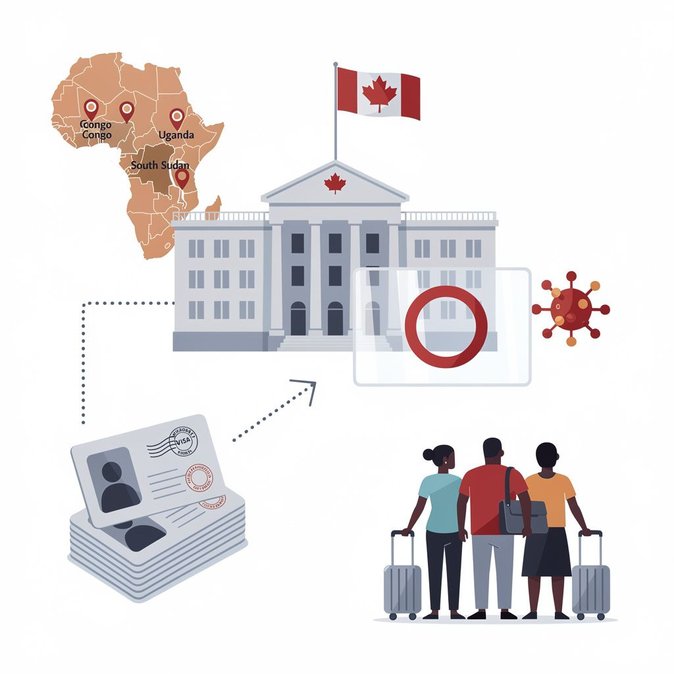
Using emergency authorities under Bill C-12, the Government of Canada has suspended decision-making on roughly 36,000 permanent-residence applications from the Democratic Republic of the Congo, Uganda and South Sudan, according to a Canada Gazette notice summarised by Asatu News on June 16. The measure also freezes 7,751 temporary-resident files and voids entry for more than 22,000 visa and eTA holders from the three countries unless they qualify for narrow humanitarian exemptions. Travellers already in Canada must undergo a 21-day quarantine if they visited the region within the previous three weeks.
At this juncture, many affected travellers and employers are turning to services like VisaHQ, whose Canada platform (https://www.visahq.com/canada/) aggregates up-to-date IRCC directives and offers personalised guidance on alternative visa pathways, documentation requirements, and contingency travel planning while the suspensions are in force.
For employers, the policy disrupts hiring pipelines that draw francophone healthcare professionals from Central Africa, a key talent source for Québec and Ontario. Companies should audit labour-market-impact assessments and provincial-nominee nominations involving the affected nationalities and prepare contingency staffing or remote-work arrangements. Immigration lawyers note this is the first broad use of Bill C-12’s power to “amend, cancel or suspend” immigration files for public-health reasons. The precedent suggests future outbreaks (e.g., yellow fever, Marburg virus) could trigger similar nationwide suspensions, adding a new layer of epidemiological risk to global mobility planning. IRCC has not announced compensation or expedited processing once the Ebola situation stabilises. Stakeholders urge the department to clarify whether time spent in suspension will count toward service-standard targets and to publish a roadmap for reinstating paused applications.
At this juncture, many affected travellers and employers are turning to services like VisaHQ, whose Canada platform (https://www.visahq.com/canada/) aggregates up-to-date IRCC directives and offers personalised guidance on alternative visa pathways, documentation requirements, and contingency travel planning while the suspensions are in force.
For employers, the policy disrupts hiring pipelines that draw francophone healthcare professionals from Central Africa, a key talent source for Québec and Ontario. Companies should audit labour-market-impact assessments and provincial-nominee nominations involving the affected nationalities and prepare contingency staffing or remote-work arrangements. Immigration lawyers note this is the first broad use of Bill C-12’s power to “amend, cancel or suspend” immigration files for public-health reasons. The precedent suggests future outbreaks (e.g., yellow fever, Marburg virus) could trigger similar nationwide suspensions, adding a new layer of epidemiological risk to global mobility planning. IRCC has not announced compensation or expedited processing once the Ebola situation stabilises. Stakeholders urge the department to clarify whether time spent in suspension will count toward service-standard targets and to publish a roadmap for reinstating paused applications.