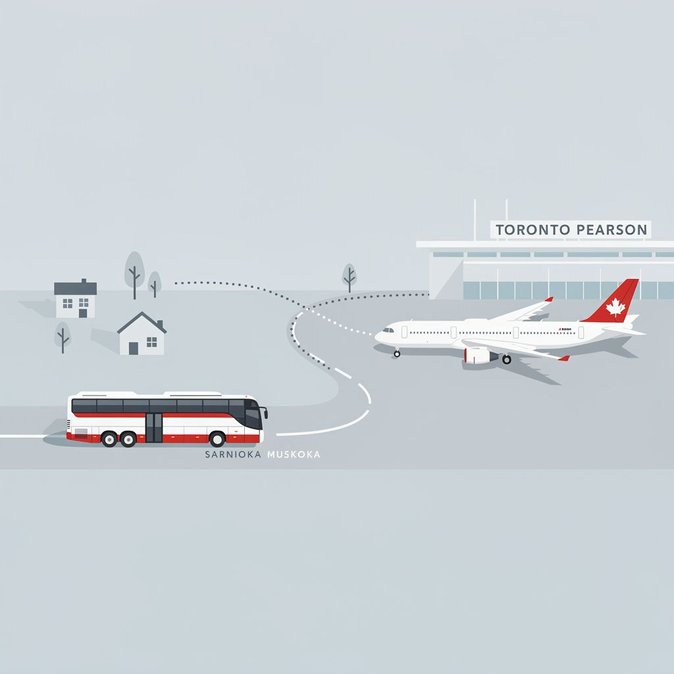
Air Canada has expanded its ground-air “Landline” network, launching twice-daily coach connections from Sarnia Chris Hadfield Airport and Muskoka Airport to Toronto Pearson International Airport. The service, operated with luxury motor coaches branded under Air Canada flight numbers, went live this week. Passengers check in at their local airport, receive a boarding pass to their final destination and through-tag any checked baggage, replicating the experience of a regional flight but with lower carbon emissions and operating costs.
As these smaller airports gain direct access to Air Canada’s global network, travellers often need visas or electronic travel authorizations for onward international journeys; VisaHQ streamlines that process by handling documentation for more than 200 countries entirely online, so passengers from Sarnia, Muskoka or Waterloo can sort their paperwork before ever stepping onto the coach. Explore the service at https://www.visahq.com/canada/
The bus stops at Region of Waterloo International Airport en route from Sarnia, expanding catchment for travellers in southwestern Ontario. For corporate travellers, the model reduces total journey time compared with self-driving, removes parking fees and guarantees missed-connection protection under Air Canada’s tariff. Companies with project sites in petrochemical-heavy Sarnia and resort-driven Muskoka can now integrate these smaller communities into global travel policies without chartering regional flights that carriers have struggled to operate profitably. Landline executives say the product eliminates 90-minute short-haul flights and associated emissions while preserving feed traffic to Air Canada’s long-haul network. Local officials call the initiative a lifeline for regional economic development after pandemic-era service cuts left many secondary airports without scheduled air links. Travel-management teams should update booking tools: Landline segments carry AC flight numbers and appear in the GDS, meaning duty-of-care tracking and carbon-reporting dashboards will capture the coach legs automatically.
As these smaller airports gain direct access to Air Canada’s global network, travellers often need visas or electronic travel authorizations for onward international journeys; VisaHQ streamlines that process by handling documentation for more than 200 countries entirely online, so passengers from Sarnia, Muskoka or Waterloo can sort their paperwork before ever stepping onto the coach. Explore the service at https://www.visahq.com/canada/
The bus stops at Region of Waterloo International Airport en route from Sarnia, expanding catchment for travellers in southwestern Ontario. For corporate travellers, the model reduces total journey time compared with self-driving, removes parking fees and guarantees missed-connection protection under Air Canada’s tariff. Companies with project sites in petrochemical-heavy Sarnia and resort-driven Muskoka can now integrate these smaller communities into global travel policies without chartering regional flights that carriers have struggled to operate profitably. Landline executives say the product eliminates 90-minute short-haul flights and associated emissions while preserving feed traffic to Air Canada’s long-haul network. Local officials call the initiative a lifeline for regional economic development after pandemic-era service cuts left many secondary airports without scheduled air links. Travel-management teams should update booking tools: Landline segments carry AC flight numbers and appear in the GDS, meaning duty-of-care tracking and carbon-reporting dashboards will capture the coach legs automatically.