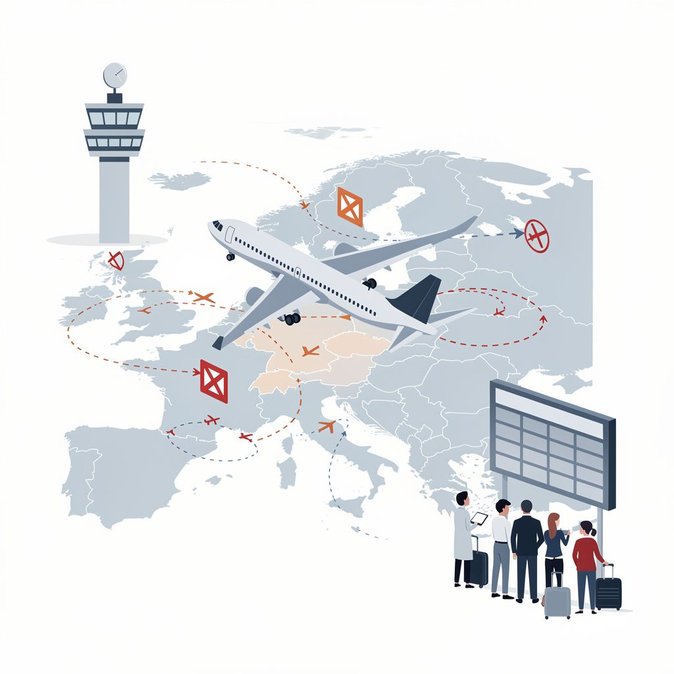
France’s notoriously strike-prone air-traffic controllers walked out again on Saturday, 20 June 2026, just as the peak summer season was getting underway. According to figures released by the European airline association Airlines for Europe and reported by Russian business wire AK&M, the 24-hour stoppage forced carriers to cancel 933 flights touching French airspace, from Paris-Charles-de-Gaulle and Orly to key regional hubs such as Lyon and Marseille. Although only about a quarter of the country’s 1,000 active controllers took part, the highly centralised nature of France’s air-traffic management meant that disruption rippled far beyond national borders. Airlines rerouted or delayed a further 600 services between the UK, Spain, Italy and Greece to avoid French skies, while low-cost carrier Ryanair warned of “rolling knock-on delays for at least 48 hours.” Business-travellers headed for Monday morning meetings faced particular uncertainty, with many scrambling for last-minute seats on Eurostar or cross-border TGVs. The walk-out is part of a long-running dispute over staffing levels and a new rostering system linked to Europe’s Single European Sky reform, which unions say will heighten fatigue and safety risks. The French transport ministry argues that the changes are essential to handle the expected 15 % jump in air movements once the Paris 2026 Summer Games test events ramp up later this year. For multinational employers, the episode is a reminder to build air-strike clauses into travel policies and to brief mobile staff on alternative routings. Forward-thinking firms are also revisiting their use of virtual or hybrid meetings during known strike windows, and advising travellers to book fully-refundable fares. Travel-risk specialists note that French air-traffic unions must file strike notices at least five days in advance, giving corporates a narrow but critical window to re-plan itineraries. While Saturday’s action was limited to 24 hours, unions have threatened a four-day stoppage from 7 October if talks fail. The prospect of recurrent disruption throughout 2026 underscores the importance of robust duty-of-care frameworks and real-time alerting tools for any organisation with employees traversing French airspace.
Source: AKM Newswire