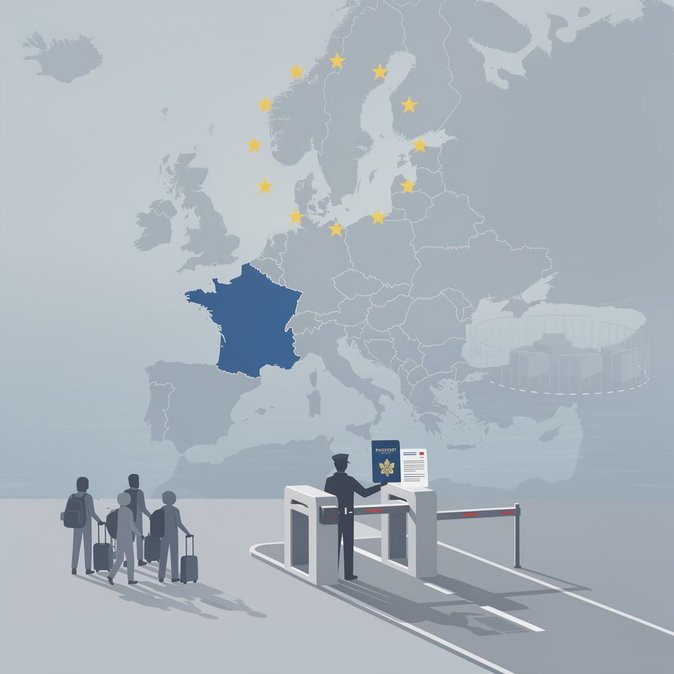
Speaking to journalists at the close of the European Council in Brussels on 19 June 2026, President Emmanuel Macron set out France’s red lines on the EU’s freshly-approved Returns Regulation. While the new law makes it easier for member states to deport people who have no legal right to remain, it also allows governments to establish processing or "return" centres in third countries willing to take deportees. Macron made clear that Paris will not participate in that model, insisting that “no centre in a third country has ever truly worked.” The French leader’s position reflects domestic political realities. Successive governments have maintained tough internal Schengen border checks since the 2015 terrorist attacks, and opinion polls show voter concern about irregular migration ahead of the 2027 legislative elections. By rejecting externalised detention sites, the Élysée distances itself from hard-right proposals while still backing faster removals through better cooperation with countries of origin and new biometric databases such as the Entry/Exit System (EES). For corporate mobility teams the message is two-fold. First, France will continue to press for efficient but legally robust return procedures inside the EU, rather than outsource them. Second, businesses should expect the current patchwork of French internal border controls to remain in place through at least October 2026, but not to be complemented by offshore camps that could further complicate family-reunification or humanitarian transfers. Practical implication: employers moving staff into or out of France can anticipate stricter document checks at road and rail crossings with Belgium, Luxembourg, Italy and Spain, yet no change to France’s existing visa categories. HR teams should brief travellers to carry proof of employment or assignment letters and factor in extra time when crossing internal EU borders, especially during peak summer travel.
Source: Reuters (via Internazionale)