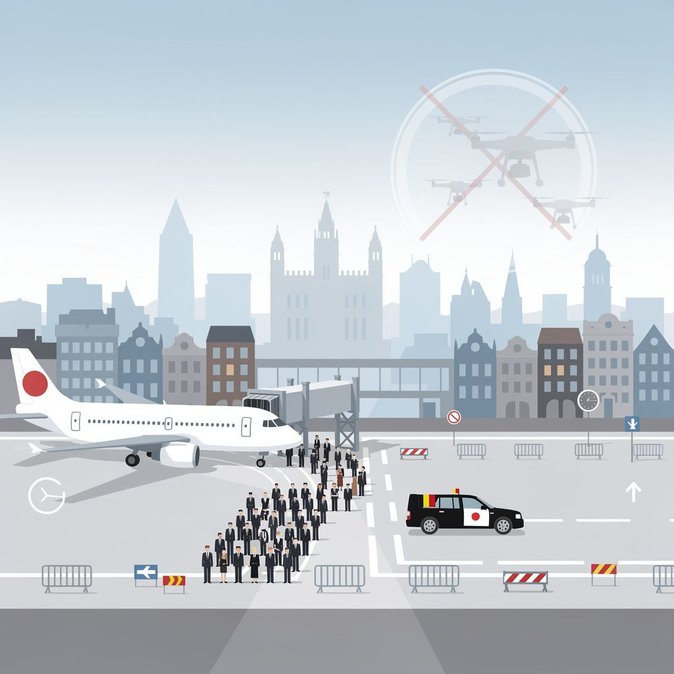
With a red-carpet welcome at Melsbroek Military Airport and a police escort through Brussels on the morning of 22 June, Emperor Naruhito and Empress Masako of Japan officially began a four-day state visit marking 160 years of Belgian-Japanese relations. While royal pageantry dominates headlines, the visit is also a complex logistics exercise that briefly reshapes mobility patterns in Belgium’s capital. Federal Police have imposed rolling road closures on the R21 inner ring and the N277 approach to Laeken Palace, the imperial couple’s residence during the stay, and have activated a temporary drone-exclusion zone over northern Brussels. BRU authorities warned passengers to arrive early on 22-23 June because VIP movements at the military side of the airport can cause short ground-handling delays on the civilian apron. Japanese delegations—over 130 officials and business leaders—are travelling on short-stay C-visas issued by the Belgian Embassy in Tokyo under an expedited diplomatic channel, underscoring Belgium’s ability to process group visas rapidly for high-level events. According to the Foreign Affairs protocol department, the visit will generate more than 900 hotel nights and an estimated €3.5 million in local spending—not insignificant for Brussels’ meetings-and-events sector, still recovering to pre-pandemic occupancy. Tuesday’s programme in central Brussels (23 June) includes a wreath-laying at the Congress Column and a bilateral economic forum at Square Convention Centre focusing on green hydrogen and life-sciences cooperation. Corporate mobility managers should note that access roads around Parc de Bruxelles and Rue Royale will be intermittently closed between 08:00 and 13:00, potentially affecting commuter shuttles and taxi transfers to EU institutions. While the disruptions are short-lived, the state visit illustrates how high-level diplomacy can ripple through Belgium’s transport ecosystem—from special visa handling to airspace restrictions—and why employers should keep real-time tabs on ceremonial events when planning itineraries for executives and assignees.
Source: New My Royals