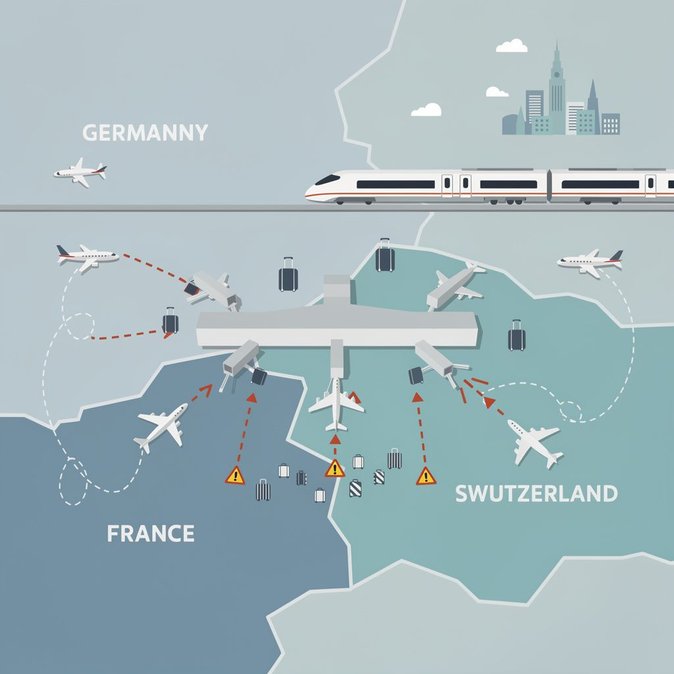
A cascading operational failure at EuroAirport Basel-Mulhouse-Freiburg on 21 June led to 62 delays and eight outright cancellations, paralysing one of Europe’s most important tri-border aviation hubs. The airport, located in France but jointly serving the Swiss city of Basel and the German city of Freiburg, handles roughly 100,000 weekly passengers—many of them German business travellers connecting to EasyJet and Lufthansa services. According to aviation-tracking data quoted by Nomad Lawyer, the disruption hit flights to and from Frankfurt, London, Paris and Amsterdam, creating knock-on delays across Lufthansa’s short-haul network. With gates grid-locked, some carriers abandoned rotations entirely to prevent crew time-outs. Because Frankfurt and Munich hubs rely on steady feeder traffic from Basel, German passengers faced missed long-haul connections and a fresh wave of EU261 compensation claims. Travel-management companies are advising corporate travellers to re-route via Zurich or Strasbourg until schedules stabilise. The incident underscores the fragility of cross-border infrastructure: a localised glitch at a shared airport can freeze mobility across three countries within minutes. Companies with commuters in the Upper Rhine tech and pharma cluster should incorporate high-speed rail contingencies—ICE and TGV links from Basel to Frankfurt and Paris remained unaffected and proved the fastest escape valve during the chaos. Airport authorities have launched a post-mortem review focusing on gate-allocation algorithms and carrier contingency planning. Further rolling delays are possible as crews and aircraft reposition.
Source: Nomad Lawyer