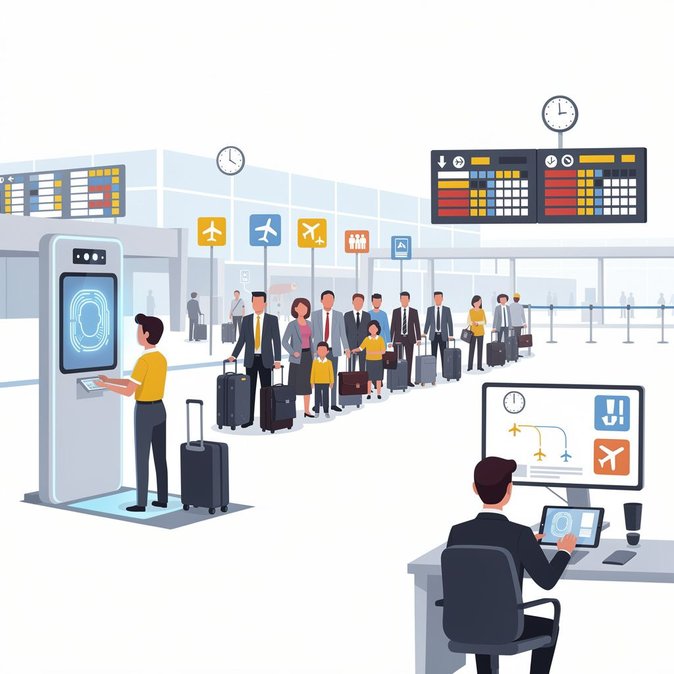
Germany’s largest hub is bracing for its busiest summer since the pandemic – and for an unprecedented bottleneck at the border. In a notice issued on 22 June, Fraport AG said it expects around nine million passengers and 60 000 aircraft movements between 26 June and 9 August. The first holiday weekend alone will see more than 616 000 travellers from the states of Hesse, Rhineland-Palatinate and Saarland. The airport operator is asking all non-EU travellers – and EU citizens flying to non-Schengen destinations – to arrive at least three hours before departure. The recommendation is driven by the new EU Entry-Exit System (EES), introduced in October 2025, which captures fingerprints and facial images of third-country nationals at every external Schengen border.
Amid the changing border formalities, travellers who want to double-check whether they need a visa or simply wish to understand how the EES might affect their journey can turn to VisaHQ’s Germany page (https://www.visahq.com/germany/). The platform provides live updates on Schengen and national visa requirements, streamlines applications for corporate road warriors and holidaymakers, and offers practical tips on navigating new biometric procedures—all before you even leave for the airport.
Although the biometric gates are designed to speed up processing in the long run, they currently add up to 60 seconds per passenger, creating tailbacks at peak times. Even intra-Schengen passengers are told to allow 2½ hours – two hours if travelling with hand luggage only. Fraport suggests pre-booking parking, reserving a security-control time-slot and using the new CT scanners in Terminals 1 and 3, which allow liquids of up to two litres and electronics to remain inside cabin bags. The operator has also reinstated the Skyline people-mover between terminals, albeit at reduced speed, to relieve landside congestion. For corporate travel managers the advice is clear: build in extra buffer time for Frankfurt connections, warn employees about potential missed flights and factor in longer duty-of-care windows. Airlines using the hub – particularly Lufthansa and its partners – are revisiting minimum-connecting-time calculations and urging travellers to download their mobile-boarding passes well in advance. Travel management companies expect a spike in re-bookings and stress that missed onward flights to Asia and the Americas could trigger additional hotel and re-routing costs.
Amid the changing border formalities, travellers who want to double-check whether they need a visa or simply wish to understand how the EES might affect their journey can turn to VisaHQ’s Germany page (https://www.visahq.com/germany/). The platform provides live updates on Schengen and national visa requirements, streamlines applications for corporate road warriors and holidaymakers, and offers practical tips on navigating new biometric procedures—all before you even leave for the airport.
Although the biometric gates are designed to speed up processing in the long run, they currently add up to 60 seconds per passenger, creating tailbacks at peak times. Even intra-Schengen passengers are told to allow 2½ hours – two hours if travelling with hand luggage only. Fraport suggests pre-booking parking, reserving a security-control time-slot and using the new CT scanners in Terminals 1 and 3, which allow liquids of up to two litres and electronics to remain inside cabin bags. The operator has also reinstated the Skyline people-mover between terminals, albeit at reduced speed, to relieve landside congestion. For corporate travel managers the advice is clear: build in extra buffer time for Frankfurt connections, warn employees about potential missed flights and factor in longer duty-of-care windows. Airlines using the hub – particularly Lufthansa and its partners – are revisiting minimum-connecting-time calculations and urging travellers to download their mobile-boarding passes well in advance. Travel management companies expect a spike in re-bookings and stress that missed onward flights to Asia and the Americas could trigger additional hotel and re-routing costs.