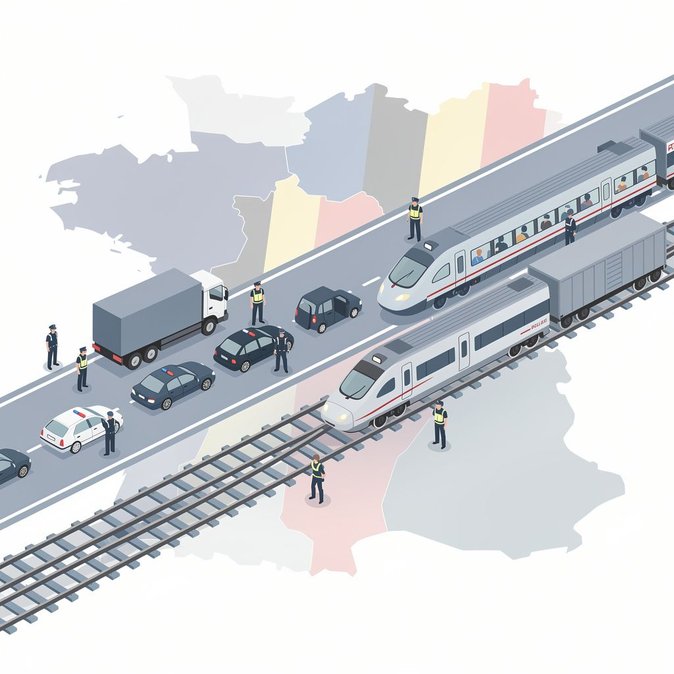
The Belgian Federal Police announced on 23 June 2026 that a week-long operation targeting drug-smuggling networks across Belgium, the Netherlands, Luxembourg and France resulted in 23 arrests and hundreds of vehicle inspections. Dubbed “Etoile III,” the 15-21 June blitz involved French gendarmes conducting joint patrols up to 30 km inside France under Schengen cross-border hot-pursuit provisions. For legitimate travellers the most visible impact was intensified spot checks on the E17, A22 and local rail services between Lille and Kortrijk, causing delays of up to 45 minutes at peak hours.
If your organisation needs to keep critical personnel moving smoothly despite such ad-hoc checks, VisaHQ can help. Our platform (https://www.visahq.com/france/) provides real-time guidance on travel documents, customs rules and transit permits so your teams know exactly what paperwork to carry when police operations tighten controls within or at the edge of Schengen.
Logistics firms reported that 11 lorries carrying just-in-time auto parts to a Renault plant in Douai were temporarily held, though all were released after documentation checks. While no new border-control measures were introduced, the episode highlights how law-enforcement campaigns can temporarily erode Schengen’s frictionless travel. Mobility managers moving staff between French and Benelux offices are advised to monitor police advisories and allow extra buffer time, especially for employees carrying sensitive prototypes or IT equipment that may attract scrutiny. French interior-ministry officials praised the operation’s success but reiterated calls for permanent Europol liaison teams stationed in Lille and Ghent to coordinate future actions—an idea likely to surface in ongoing negotiations over Schengen Border Code reform.
If your organisation needs to keep critical personnel moving smoothly despite such ad-hoc checks, VisaHQ can help. Our platform (https://www.visahq.com/france/) provides real-time guidance on travel documents, customs rules and transit permits so your teams know exactly what paperwork to carry when police operations tighten controls within or at the edge of Schengen.
Logistics firms reported that 11 lorries carrying just-in-time auto parts to a Renault plant in Douai were temporarily held, though all were released after documentation checks. While no new border-control measures were introduced, the episode highlights how law-enforcement campaigns can temporarily erode Schengen’s frictionless travel. Mobility managers moving staff between French and Benelux offices are advised to monitor police advisories and allow extra buffer time, especially for employees carrying sensitive prototypes or IT equipment that may attract scrutiny. French interior-ministry officials praised the operation’s success but reiterated calls for permanent Europol liaison teams stationed in Lille and Ghent to coordinate future actions—an idea likely to surface in ongoing negotiations over Schengen Border Code reform.