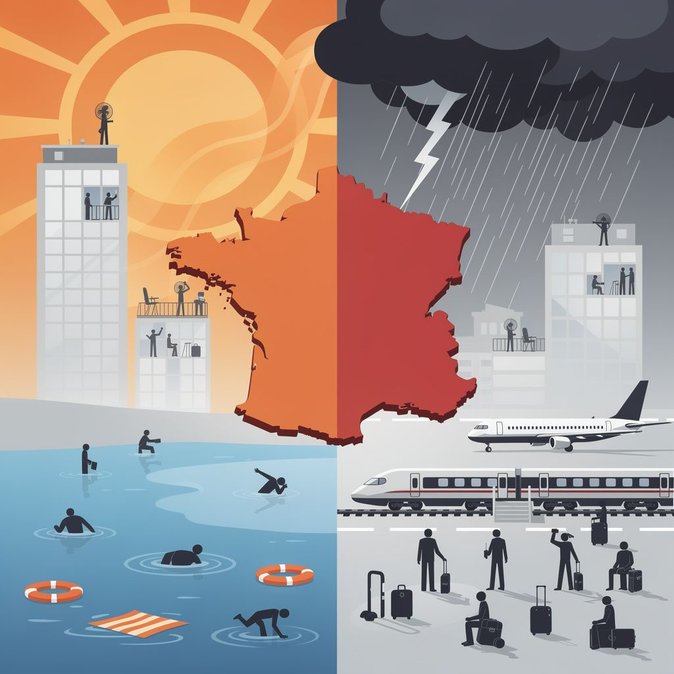
Reuters reporting on 23 June revealed that at least 40 people drowned in France while seeking relief from the record heat, highlighting wider safety and mobility implications of extreme weather. The prime minister said the deaths occurred largely in unsupervised rivers and canals between 18 and 23 June. The same heatwave forced the cancellation of multiple Paris–Brussels high-speed services and led Eurostar to warn passengers to travel only if essential.
Travel managers looking for up-to-date entry requirements or contingency guidance can tap VisaHQ’s France portal, which aggregates visa rules, safety notices and real-time transport alerts in one place. The platform (https://www.visahq.com/france/) also offers expedited documentation services and on-the-ground support, helping organisations reroute staff or extend stays when weather disrupts planned itineraries.
At several French regional airports thunderstorms associated with the "Omega" heat dome caused evening diversions and further delays, compounding earlier ground-temperature stoppages. Business groups reported productivity losses as outdoor worksites shut down after midday and delivery firms limited driver hours. Insurance brokers forecast a spike in corporate travel-insurance claims for missed connections and medical emergencies. Global-mobility teams are advised to integrate meteorological thresholds into duty-of-care protocols—triggering remote-work options or hotel day-use rooms when the heat index surpasses 39 °C—and to clarify cover for leisure activities undertaken by employees on assignment. Consular authorities reiterated that drowning incidents could affect local rescue capacity just as tourists begin peak summer arrivals.
Travel managers looking for up-to-date entry requirements or contingency guidance can tap VisaHQ’s France portal, which aggregates visa rules, safety notices and real-time transport alerts in one place. The platform (https://www.visahq.com/france/) also offers expedited documentation services and on-the-ground support, helping organisations reroute staff or extend stays when weather disrupts planned itineraries.
At several French regional airports thunderstorms associated with the "Omega" heat dome caused evening diversions and further delays, compounding earlier ground-temperature stoppages. Business groups reported productivity losses as outdoor worksites shut down after midday and delivery firms limited driver hours. Insurance brokers forecast a spike in corporate travel-insurance claims for missed connections and medical emergencies. Global-mobility teams are advised to integrate meteorological thresholds into duty-of-care protocols—triggering remote-work options or hotel day-use rooms when the heat index surpasses 39 °C—and to clarify cover for leisure activities undertaken by employees on assignment. Consular authorities reiterated that drowning incidents could affect local rescue capacity just as tourists begin peak summer arrivals.