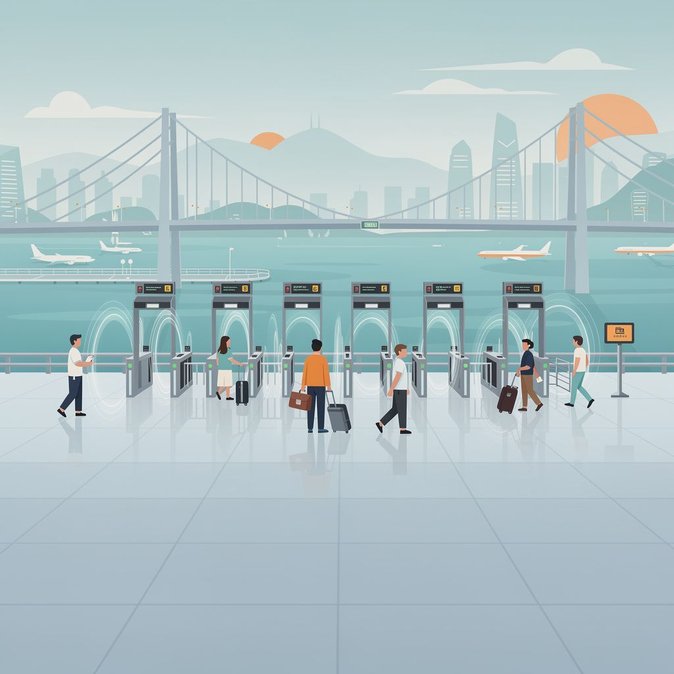
Hong Kong is set to introduce its first “seamless” or “no-stop” automated immigration channel at the Hong Kong-Zhuhai-Macao Bridge control point on 25 June. A detailed explainer released by Headline Daily on 23 June confirms that eligible Hong Kong permanent residents aged 11 or above who have used the bridge at least ten times in the past 90 days can pre-register for the service. Once enrolled, travellers will simply walk through a dedicated lane without stopping to present a passport or Hong Kong Identity Card; cameras will verify facial geometry and gait in about five seconds, and the exit gate opens automatically. The “no-stop e-Channel” is part of the Immigration Department’s broader “Smart Customs, Smart Border” blueprint announced in the 2025 Policy Address. Officials hope to relieve peak-hour congestion at the bridge, which handled close to nine million passenger movements last year. The pilot will initially accommodate 50,000 frequent users; capacity will be expanded to other land checkpoints if real-world performance matches laboratory tests. Travellers who prefer traditional clearance can still use existing e-Channels or manned counters. For corporate mobility teams, the innovation could shave minutes off cross-boundary commutes for staff who live in Guangdong but work in Hong Kong—or vice-versa—improving punctuality and reducing transport costs. Logistic firms expect smoother driver rotations for just-in-time deliveries, while labour-intensive sectors such as hospitality anticipate easier scheduling of Macao-based shift workers coming to Hong Kong for short assignments. Officials caution that enrolment is voluntary and that biometric templates will be stored in an encrypted, isolated government cloud. Companies with frequent cross-border travellers should update travel policies to include time for one-off registration at the bridge departure hall and to brief staff on data-privacy consent forms. Employers are also advised to keep contingency plans because adverse weather or system downtimes will temporarily divert passengers back to conventional channels. Immigration experts see the launch as a stepping-stone toward a Greater Bay Area “single-token” system in which a single facial scan could clear both Hong Kong and mainland checkpoints. That concept is still politically sensitive, but the 25 June roll-out will provide a live proof-of-concept for frictionless regional mobility.
Source: Headline Daily