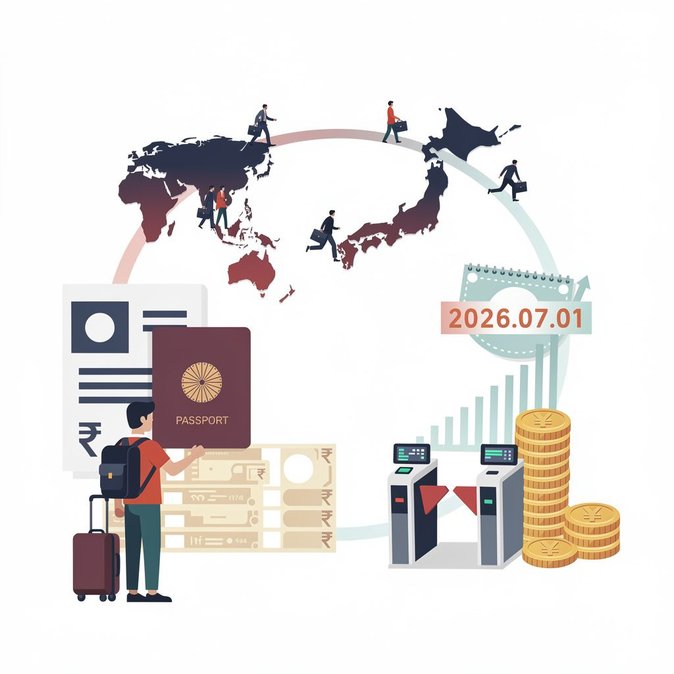
Japanese holiday plans will soon become costlier for Indian passport-holders. In a cabinet decision published on June 23, 2026, Tokyo approved the first comprehensive revision of its visa tariff schedule since 1978. From 1 July a single-entry Japanese visa for nationals who still require prior authorisation—including India, China and the Philippines—will rise from roughly ₹1,760 to about ₹8,800, while a multiple-entry visa will jump from about ₹3,500 to nearly ₹17,600. Fee ceilings for long-term residence categories have also been increased. The Ministry of Foreign Affairs said the sharp adjustment reflects almost five decades of inflation, a weaker yen and higher administrative costs linked to record foreign-resident numbers (4.13 million by end-2025). Additional revenue is earmarked for digital border-control projects and Japanese-language integration programmes. The change leaves travellers from more than 70 visa-waiver countries—such as the US, the UK and most of Europe—unaffected, sharpening the cost differential for emerging-market visitors. For India, which is now Japan’s fastest-growing long-haul market, the news lands at the start of the July–August holiday season. Tour operators estimate that a family of four will have to budget an extra ₹25,000–₹30,000 in up-front paperwork costs before flights and hotels. Some budget travellers may postpone trips or pivot to visa-free destinations in South-East Asia. Business travel analysts believe corporate traffic will largely absorb the increase, arguing that Japan’s weak currency still makes on-ground expenses attractive and that a streamlined e-visa pilot expected in late 2026 will offset some friction. Nevertheless, companies with large project teams in Japan are advising staff to switch to multiple-entry applications before July to lock in the lower fee. Diplomats in New Delhi said India respects Japan’s sovereign right to adjust fees but hopes Tokyo will fast-track talks on mutual recognition of trusted-traveller programmes so that people-to-people ties continue to deepen without price being a barrier.
Source: The Logical Indian