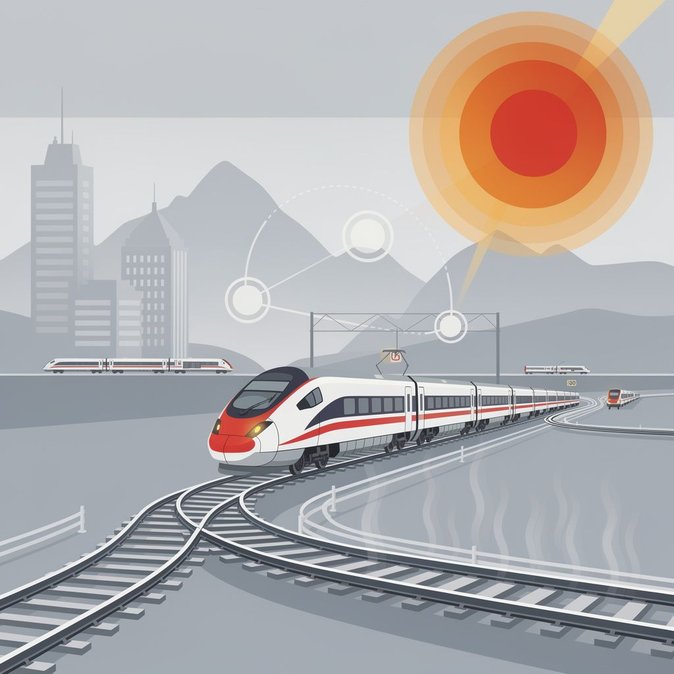
Austria’s national railway, Österreichische Bundesbahnen (ÖBB), issued an unusual public appeal on Friday, 26 June, asking passengers to avoid non-essential train travel over the coming days. Temperatures approaching 40 °C are already causing rail steel to expand; engineers reported the first minor track distortions on the Vienna–Linz high-speed section shortly after midday.
If urgent journeys cannot be postponed and involve cross-border elements, travellers may also need to update travel documents at short notice. VisaHQ can step in here, offering fast visa processing, passport renewals and electronic authorisations for Austria and dozens of other destinations through its online portal (https://www.visahq.com/austria/), helping companies keep mobility plans flexible even when rail timetables are not.
To guarantee safety, ÖBB has ordered immediate speed reductions on several exposed corridors and warned that ad-hoc line closures may follow if rails or overhead catenaries reach critical temperatures. The carrier said maintenance crews equipped with mobile infrared scanners are inspecting vulnerable stretches “around the clock”, but added that “extreme weather cannot be fully compensated even with modern materials”. The appeal matters for corporate mobility managers because Austria’s rail network is the backbone of domestic business travel and a key feeder for Vienna International Airport. A 20 % reduction in average line speed translates into delays of up to 45 minutes on the busy Westbahn alone, complicating tight flight connections and same-day meetings. Companies with commuter allowances and climate-bonus programmes were advised to authorise remote work where possible. ÖBB recommended that travellers who must ride take extra water, check the ÖBB app before departure, and build “generous” time buffers. It also reminded passengers that flexible Sparschiene tickets purchased before 22 June can be rebooked without penalty until heat warnings are lifted—an exception to normal fare rules. The episode underscores how climate-driven heat extremes are now operational as well as environmental risks. With the Alps forecast to warm twice as fast as the global average, the Ministry of Climate Action has budgeted €180 million through 2028 to retrofit sleepers and install automated track-cooling systems, but only 12 % of the network has been upgraded so far.
If urgent journeys cannot be postponed and involve cross-border elements, travellers may also need to update travel documents at short notice. VisaHQ can step in here, offering fast visa processing, passport renewals and electronic authorisations for Austria and dozens of other destinations through its online portal (https://www.visahq.com/austria/), helping companies keep mobility plans flexible even when rail timetables are not.
To guarantee safety, ÖBB has ordered immediate speed reductions on several exposed corridors and warned that ad-hoc line closures may follow if rails or overhead catenaries reach critical temperatures. The carrier said maintenance crews equipped with mobile infrared scanners are inspecting vulnerable stretches “around the clock”, but added that “extreme weather cannot be fully compensated even with modern materials”. The appeal matters for corporate mobility managers because Austria’s rail network is the backbone of domestic business travel and a key feeder for Vienna International Airport. A 20 % reduction in average line speed translates into delays of up to 45 minutes on the busy Westbahn alone, complicating tight flight connections and same-day meetings. Companies with commuter allowances and climate-bonus programmes were advised to authorise remote work where possible. ÖBB recommended that travellers who must ride take extra water, check the ÖBB app before departure, and build “generous” time buffers. It also reminded passengers that flexible Sparschiene tickets purchased before 22 June can be rebooked without penalty until heat warnings are lifted—an exception to normal fare rules. The episode underscores how climate-driven heat extremes are now operational as well as environmental risks. With the Alps forecast to warm twice as fast as the global average, the Ministry of Climate Action has budgeted €180 million through 2028 to retrofit sleepers and install automated track-cooling systems, but only 12 % of the network has been upgraded so far.