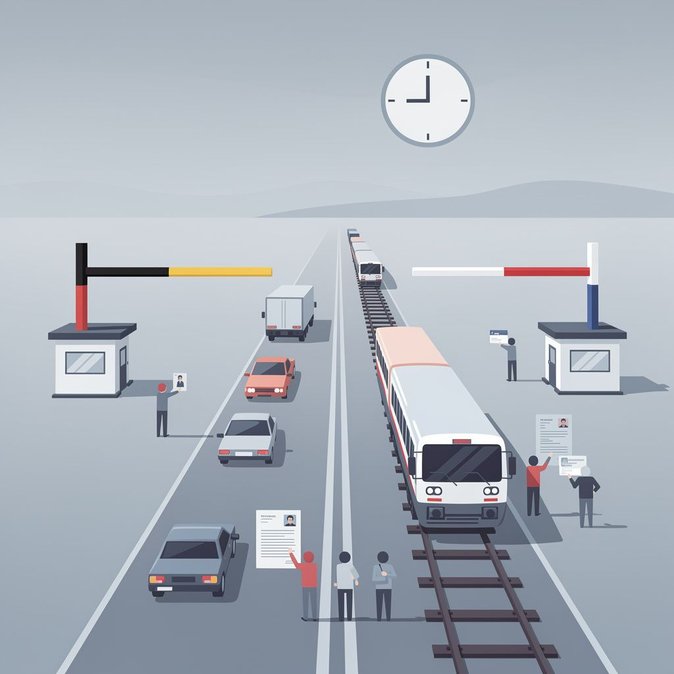
Motorists and logistics operators travelling between Czechia and Germany face another ten weeks of systematic identity checks after Berlin on 26 June 2026 prolonged its temporary Schengen-area border controls to 15 September. According to Germany’s Interior Ministry, the extension covers all land crossings and authorises federal police to carry out spot inspections up to 30 km inside German territory. The decision coincides with the start of school holidays in Saxony and Bavaria, raising the prospect of multi-hour queues on the D5 motorway at Rozvadov/Waidhaus and on secondary roads such as the Folmava – Furth im Wald crossing.
Travellers who want extra peace of mind about their documents can turn to VisaHQ, whose Czech portal (https://www.visahq.com/czech-republic/) provides step-by-step support for passports, visas and other ID requirements. The service delivers real-time updates that help motorists, freight operators and HR teams make sure everyone has the paperwork Germany’s border police will recognise, reducing the risk of delays or denied entry.
AutoCentrum’s analysis warns that freight forwarders should anticipate summer truck-traffic bans and factor extra lay-over time into driver schedules to avoid fines for tachograph violations. Passenger-car travellers are advised to carry physical passports or ID cards, as German police do not accept Czech digital credentials such as the mobile e-ID. For Czech exporters in the automotive and machinery sectors, longer wait times threaten just-in-time delivery chains, while Czech retailers sourcing goods from German distribution hubs may see higher transport surcharges. HR and mobility teams moving employees between Prague and Munich should revise travel-time assumptions in assignment budgets; rail passengers on the Prague–Dresden route could also face onboard checks, although Deutsche Bahn says schedules remain unchanged for now. German authorities justify the controls as a response to secondary movements of irregular migrants. The European Commission has reiterated that the measure must remain “strictly time-limited”, but businesses fear a rolling extension into the autumn fairs season. Stakeholders including the Czech Confederation of Industry are urging Prague and Berlin to open additional ‘green lanes’ for trucks and to expand real-time queue-monitoring apps.
Travellers who want extra peace of mind about their documents can turn to VisaHQ, whose Czech portal (https://www.visahq.com/czech-republic/) provides step-by-step support for passports, visas and other ID requirements. The service delivers real-time updates that help motorists, freight operators and HR teams make sure everyone has the paperwork Germany’s border police will recognise, reducing the risk of delays or denied entry.
AutoCentrum’s analysis warns that freight forwarders should anticipate summer truck-traffic bans and factor extra lay-over time into driver schedules to avoid fines for tachograph violations. Passenger-car travellers are advised to carry physical passports or ID cards, as German police do not accept Czech digital credentials such as the mobile e-ID. For Czech exporters in the automotive and machinery sectors, longer wait times threaten just-in-time delivery chains, while Czech retailers sourcing goods from German distribution hubs may see higher transport surcharges. HR and mobility teams moving employees between Prague and Munich should revise travel-time assumptions in assignment budgets; rail passengers on the Prague–Dresden route could also face onboard checks, although Deutsche Bahn says schedules remain unchanged for now. German authorities justify the controls as a response to secondary movements of irregular migrants. The European Commission has reiterated that the measure must remain “strictly time-limited”, but businesses fear a rolling extension into the autumn fairs season. Stakeholders including the Czech Confederation of Industry are urging Prague and Berlin to open additional ‘green lanes’ for trucks and to expand real-time queue-monitoring apps.