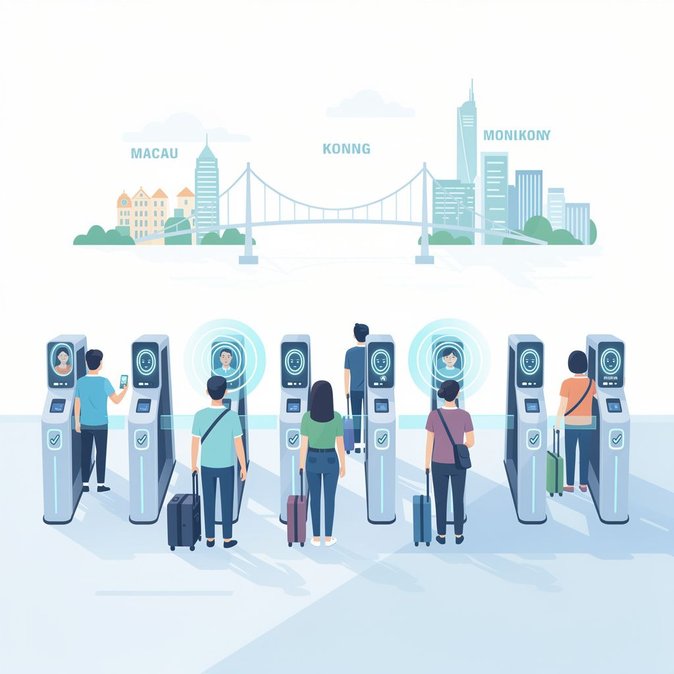
One day after Hong Kong’s document-free lanes debuted, Macau followed suit. On 26 June the Public Security Police Force and Zhuhai border-inspection authorities switched all 204 automated channels at Qingmao Port and the Zhuhai-Macao hall of the Hong Kong-Zhuhai-Macao Bridge over to “face-scan” clearance. The upgrade means that every joint-inspection land checkpoint serving Macau now supports biometric walk-through processing. The technology was first piloted at Hengqin Port in November 2025, where more than 6.2 million passenger trips—42 % of total throughput—have already been processed. After six months of stable operations, officials stress-tested the software and hardware at the new sites through late April and ran live trials in May involving 170,000 volunteers. The full launch went ahead after those trials cut average processing times to eight seconds and error rates to under 0.2 %, according to the Public Security Forces Affairs Bureau. Eligibility mirrors the Hengqin rules: Macau residents, Hong Kong permanent residents and mainland Chinese citizens aged 14 or above may use the gates once they complete a one-time registration. Travellers from Taiwan, foreign passport holders and minors still need to present documents. Officers can also request traditional IDs for spot checks, so passengers must carry them even when using the fast lane. For Hong Kong’s business community the extension is significant. Qingmao Port, located beside Zhuhai Railway Station, has become the preferred crossing for IT and finance professionals commuting to Hengqin’s steadily growing innovation zone. Adding facial recognition here shaves minutes off the daily journey and aligns border processes on both sides of the Pearl River Delta. The twin upgrades underscore a broader regional race to digitise border control. With Shenzhen’s Futian Port set to unveil similar lanes later this summer and Hong Kong eyeing city-wide rollout of its “Seamless e-Channel”, cross-boundary commutes within the Greater Bay Area could soon resemble domestic travel—provided privacy safeguards keep pace.
Source: China Daily Asia