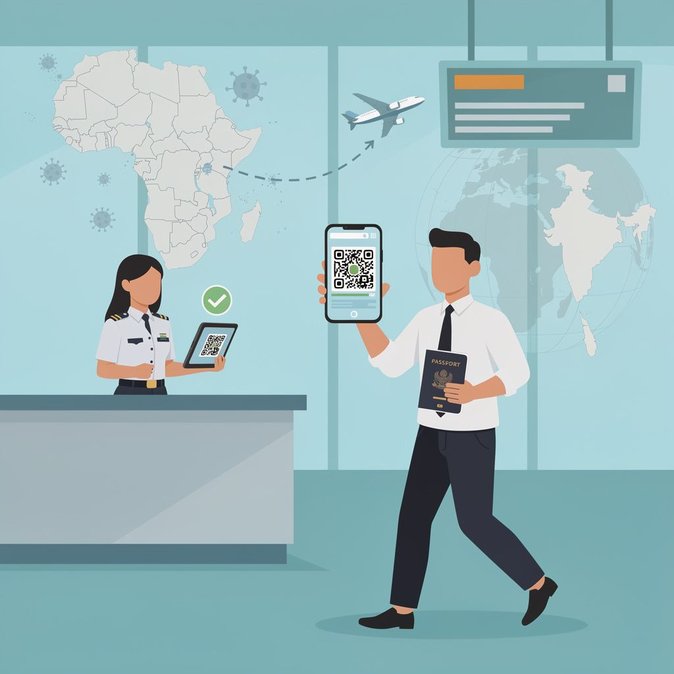
India’s Ministry of Health and Family Welfare has quietly re-activated its Air Suvidha health-declaration portal—relaunched as “Air Suvidha 2.0”—after a two-year dormancy. From 00:01 IST on 26 June 2026, every passenger bound for India, irrespective of nationality or point of origin, must complete a digital Self-Declaration Form (SDF) at least six hours before departure. The form captures a 21-day travel history, contact details, seat number, vaccination status and a symptom checklist. Travellers receive a QR-coded approval that must be shown (digital or printed) to airline staff at the boarding gate and later to immigration or the International Travel Health Desk on arrival. Officials stressed that the measure is temporary and specifically linked to the World Health Organization’s rapid-risk assessment of the widening Ebola outbreak in parts of Uganda, the Democratic Republic of Congo and South Sudan. While no Ebola cases have been detected in India, New Delhi is applying the “precautionary principle” after modelling showed that roughly 7,000 passengers a week connect to India through African hubs such as Addis Ababa, Nairobi and Doha. Airlines have been told to deny boarding to passengers who cannot show the SDF QR code. Carriers operating red-eye services from Europe and the Gulf are lobbying for a four-hour waiver during the first week, citing tight connection windows. Airports Authority of India (AAI) says e-gates will be enabled to scan the QR code at six major airports (Delhi, Mumbai, Bengaluru, Hyderabad, Chennai and Kochi) by 1 July. For businesses, the administrative burden is minor compared with pandemic-era requirements, but mobility managers should update traveller checklists immediately, especially for last-minute trips. Companies with large expatriate populations rotating in from Africa may wish to pre-populate employee data through the portal’s new API, which supports bulk uploads for corporate accounts. Analysts note that India’s decision underscores how health security has become a standing element of border management. Many expect Air Suvidha 2.0 to remain dormant, ready to be toggled on whenever global public-health risks spike—even after the Ebola threat subsides.