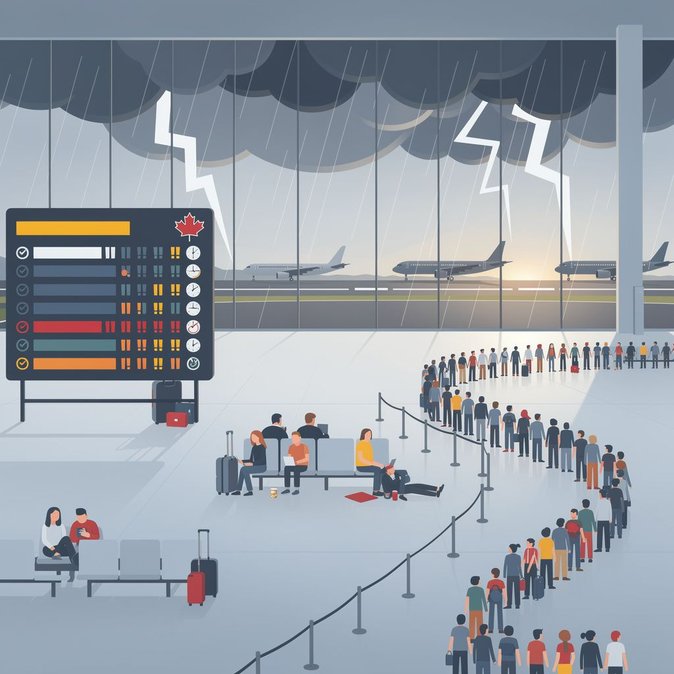
Travellers using Toronto Pearson International Airport on June 28, 2026 faced one of the most chaotic summer Sundays in recent memory. A fast-moving thunderstorm cell rolled across the Greater Toronto Area just after sunrise, forcing ground-handling crews to pause ramp operations for nearly 90 minutes.
During crunch moments like this, VisaHQ can be a lifesaver for international passengers: its Canada platform (https://www.visahq.com/canada/) streamlines urgent eTA and visa processing and connects travellers to on-call specialists who can fast-track documentation updates when sudden weather or ATC disruptions force itinerary changes.
The backlog that followed rippled through the entire day: flight-tracking portal NomadLawyer counted 179 delays and 11 outright cancellations affecting eight carriers, including Air Canada, WestJet, British Airways and Lufthansa. Air Canada alone reported 48 delayed mainline departures, with its Jazz and Rouge affiliates adding another 54 disruptions. Although most delays were under two hours, the concentration of disrupted flights during the morning “East-coast bank” meant missed connections for hundreds of trans-Atlantic passengers. Pearson’s transborder Terminal 1 security queues peaked at 62 minutes, according to real-time sensors. The Greater Toronto Airports Authority deployed additional customer-service volunteers and opened an overflow holding area in the Link Train corridor, but bottlenecks at customs remained until early evening. Airlines invoked their tariff provisions for “weather and ATC” to deny hotel vouchers, leaving many travellers scrambling to rebook on the same day. Seasoned road warriors noted that Air Canada’s digital re-accommodation tool worked best before arriving at the airport; kiosks inside the terminal repeatedly crashed under heavy load. Travel-management companies advised corporate clients to book flexible fares during the Canada Day long-weekend window and to build at least a four-hour buffer before onward long-haul sectors. Operationally, the disruption illustrated the razor-thin margin Toronto Pearson is working with as summer traffic climbs toward pre-pandemic records. GTAA officials have warned for months that runway construction, coupled with a shortage of licensed air-traffic controllers, would reduce capacity during peak periods. Sunday’s storm merely exposed how fast the network can seize up when another variable—weather—enters the equation. For mobility managers, the message is clear: build resilience into itineraries through multi-carrier booking options, real-time monitoring tools and traveller self-service authorisations. With the FIFA World Cup and a slew of summertime events converging on Canada, even brief weather holds can cascade into full-day meltdowns.
During crunch moments like this, VisaHQ can be a lifesaver for international passengers: its Canada platform (https://www.visahq.com/canada/) streamlines urgent eTA and visa processing and connects travellers to on-call specialists who can fast-track documentation updates when sudden weather or ATC disruptions force itinerary changes.
The backlog that followed rippled through the entire day: flight-tracking portal NomadLawyer counted 179 delays and 11 outright cancellations affecting eight carriers, including Air Canada, WestJet, British Airways and Lufthansa. Air Canada alone reported 48 delayed mainline departures, with its Jazz and Rouge affiliates adding another 54 disruptions. Although most delays were under two hours, the concentration of disrupted flights during the morning “East-coast bank” meant missed connections for hundreds of trans-Atlantic passengers. Pearson’s transborder Terminal 1 security queues peaked at 62 minutes, according to real-time sensors. The Greater Toronto Airports Authority deployed additional customer-service volunteers and opened an overflow holding area in the Link Train corridor, but bottlenecks at customs remained until early evening. Airlines invoked their tariff provisions for “weather and ATC” to deny hotel vouchers, leaving many travellers scrambling to rebook on the same day. Seasoned road warriors noted that Air Canada’s digital re-accommodation tool worked best before arriving at the airport; kiosks inside the terminal repeatedly crashed under heavy load. Travel-management companies advised corporate clients to book flexible fares during the Canada Day long-weekend window and to build at least a four-hour buffer before onward long-haul sectors. Operationally, the disruption illustrated the razor-thin margin Toronto Pearson is working with as summer traffic climbs toward pre-pandemic records. GTAA officials have warned for months that runway construction, coupled with a shortage of licensed air-traffic controllers, would reduce capacity during peak periods. Sunday’s storm merely exposed how fast the network can seize up when another variable—weather—enters the equation. For mobility managers, the message is clear: build resilience into itineraries through multi-carrier booking options, real-time monitoring tools and traveller self-service authorisations. With the FIFA World Cup and a slew of summertime events converging on Canada, even brief weather holds can cascade into full-day meltdowns.