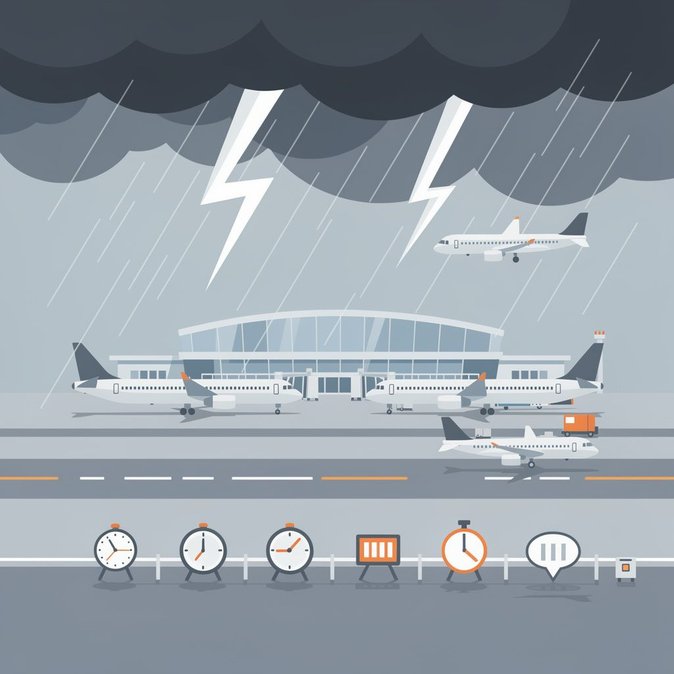
After Britain’s hottest June day on record, violent storms swept across south-east England on Sunday, 28 June 2026, forcing London Heathrow and Gatwick to slash runway capacity and triggering the delay of more than 900 flights. Aviation24.be reports that some disruptions lasted up to 11 hours, with a British Airways Santiago–London service diverted and rescheduled to arrive 11 hours late. Air-traffic control provider NATS introduced flow restrictions to keep aircraft clear of convective weather cells, while Eurocontrol flagged the London TMA as Europe’s most congested airspace for the day.
For travellers suddenly rerouted through alternative hubs or needing emergency stopovers, VisaHQ’s rapid visa and transit-document services can prevent itinerary changes from turning into administrative headaches. The company’s platform—https://www.visahq.com/united-kingdom/—helps passengers secure Schengen, US ESTA, and other essential clearances within hours, offering a practical safeguard when extreme weather throws travel plans into disarray.
As operations backed up, airlines scrambled for crew-hours and parking stands, prompting dozens of cancellations, missed connections and freight knock-on effects. The disruption coincided with the run-up to the UK school summer-holiday peak, magnifying the impact on corporate itineraries and time-sensitive cargo. Travel-management companies (TMCs) activated contingency plans, rerouting executives via Manchester and European hubs or advising clients to switch to Eurostar—only to find rail services later hampered by the same weather system. Insurers reminded travellers that EU261/UK261 compensation may not apply because thunderstorms count as “extraordinary circumstances,” although duty-of-care standards still require providing meals and accommodation. The episode underscores how climate-driven extreme-weather volatility is rapidly becoming a board-level mobility risk. Firms with high intra-EU travel volumes should revisit split-site working, virtual-meeting back-ups and flexible ticketing policies. Heathrow and Gatwick themselves face renewed scrutiny of resilience planning as they pursue capacity upgrades later this decade.
For travellers suddenly rerouted through alternative hubs or needing emergency stopovers, VisaHQ’s rapid visa and transit-document services can prevent itinerary changes from turning into administrative headaches. The company’s platform—https://www.visahq.com/united-kingdom/—helps passengers secure Schengen, US ESTA, and other essential clearances within hours, offering a practical safeguard when extreme weather throws travel plans into disarray.
As operations backed up, airlines scrambled for crew-hours and parking stands, prompting dozens of cancellations, missed connections and freight knock-on effects. The disruption coincided with the run-up to the UK school summer-holiday peak, magnifying the impact on corporate itineraries and time-sensitive cargo. Travel-management companies (TMCs) activated contingency plans, rerouting executives via Manchester and European hubs or advising clients to switch to Eurostar—only to find rail services later hampered by the same weather system. Insurers reminded travellers that EU261/UK261 compensation may not apply because thunderstorms count as “extraordinary circumstances,” although duty-of-care standards still require providing meals and accommodation. The episode underscores how climate-driven extreme-weather volatility is rapidly becoming a board-level mobility risk. Firms with high intra-EU travel volumes should revisit split-site working, virtual-meeting back-ups and flexible ticketing policies. Heathrow and Gatwick themselves face renewed scrutiny of resilience planning as they pursue capacity upgrades later this decade.