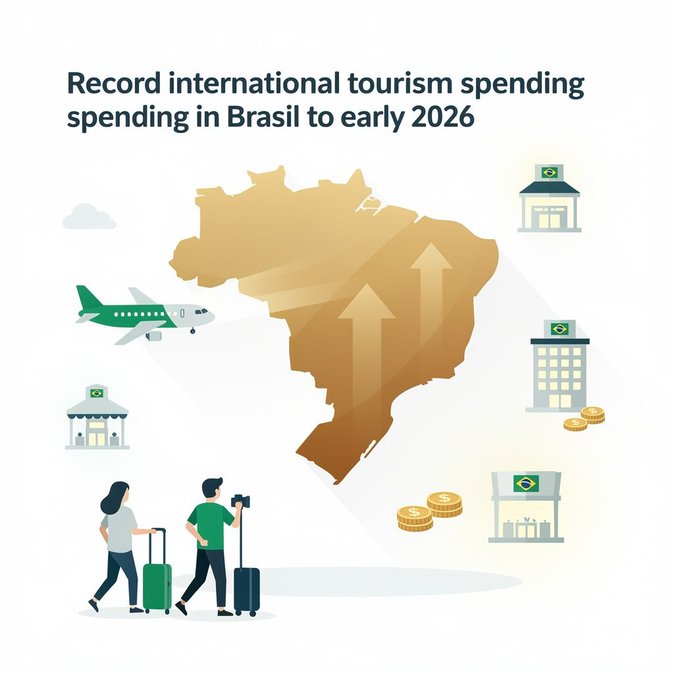
The Ministry of Tourism reports that international tourists spent R$ 25 billion (US$ 4.55 billion) in Brazil between January and May 2026—the highest amount ever recorded for the period and an 11 % increase over 2025. May alone saw expenditures of R$ 4.08 billion, up 19 %.
Whether you’re a leisure traveler eyeing Brazil’s beaches or a corporate road warrior arranging multi-city itineraries, VisaHQ can streamline the paperwork. The platform’s Brazil-specific portal (https://www.visahq.com/brazil/) lets users verify the latest entry rules, complete e-visa applications, and get expert support on required documents—simplifying travel at a time when the country’s visa policies are changing rapidly.
The spending boom correlates with stronger air connectivity and targeted visa-facilitation measures. Notably, arrivals from China rose 75 % year-on-year in May after Brazil unilaterally waived tourist and business visas for Chinese nationals until 31 December 2026. Analysts also attribute gains to the post-pandemic resumption of cruise itineraries and events such as São Paulo Fashion Week, which lured high-spending segments. For multinational companies with Brazilian entities, the uptick signals renewed demand for corporate accommodation and MICE venues. Hotel daily rates in Rio de Janeiro climbed 14 % in the first half of June, and São Paulo’s premium coworking occupancy hit 92 %, according to industry trackers. Travel buyers should budget for elevated costs through at least Q3 2026. The Central Bank’s figures are encouraging for policymakers seeking to diversify Brazil’s services balance, but they also highlight infrastructure pressure points. Embratur is accelerating airport-city rail projects in Rio and Salvador to cope with forecast arrivals surpassing 7 million by year-end. Stakeholders expect the visa waiver for China to be extended or made reciprocal—negotiations are slated for October—which could further reshape Brazil’s inbound tourism mix in 2027.
Whether you’re a leisure traveler eyeing Brazil’s beaches or a corporate road warrior arranging multi-city itineraries, VisaHQ can streamline the paperwork. The platform’s Brazil-specific portal (https://www.visahq.com/brazil/) lets users verify the latest entry rules, complete e-visa applications, and get expert support on required documents—simplifying travel at a time when the country’s visa policies are changing rapidly.
The spending boom correlates with stronger air connectivity and targeted visa-facilitation measures. Notably, arrivals from China rose 75 % year-on-year in May after Brazil unilaterally waived tourist and business visas for Chinese nationals until 31 December 2026. Analysts also attribute gains to the post-pandemic resumption of cruise itineraries and events such as São Paulo Fashion Week, which lured high-spending segments. For multinational companies with Brazilian entities, the uptick signals renewed demand for corporate accommodation and MICE venues. Hotel daily rates in Rio de Janeiro climbed 14 % in the first half of June, and São Paulo’s premium coworking occupancy hit 92 %, according to industry trackers. Travel buyers should budget for elevated costs through at least Q3 2026. The Central Bank’s figures are encouraging for policymakers seeking to diversify Brazil’s services balance, but they also highlight infrastructure pressure points. Embratur is accelerating airport-city rail projects in Rio and Salvador to cope with forecast arrivals surpassing 7 million by year-end. Stakeholders expect the visa waiver for China to be extended or made reciprocal—negotiations are slated for October—which could further reshape Brazil’s inbound tourism mix in 2027.