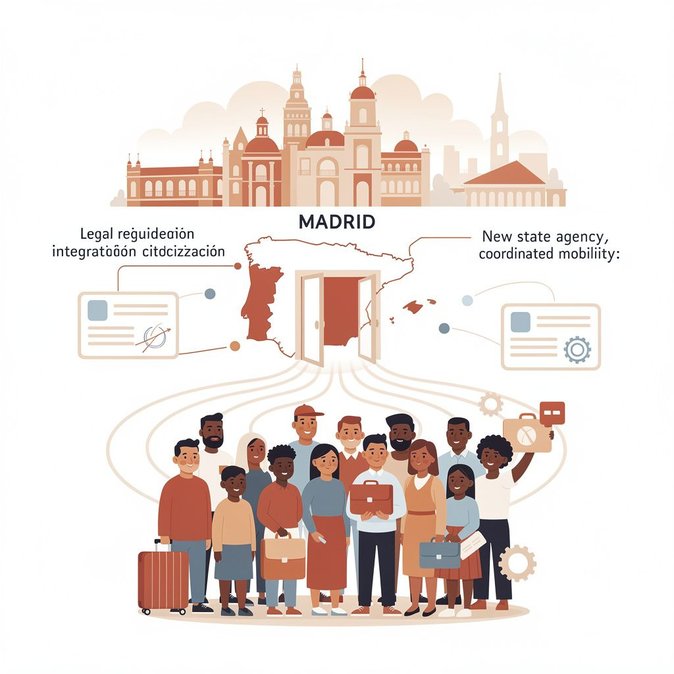
Responding to the Supreme Court’s doubts, the Spanish government publicly reaffirmed on 30 June that its extraordinary regularisation “fully respects EU law”. At the same Madrid event, Prime Minister Pedro Sánchez presented a €500 million Integration and Citizenship Plan for 2026, designed to convert new residence permits into long-term social and economic inclusion. The four-pillar plan includes: a national Mobility Labour Strategy to match migrants with hard-to-fill jobs; €150 million for flexible vocational-training places; nearly €30 million for language and civic-orientation courses; and the creation of a State Agency for Human Mobility to streamline future residence procedures.
Employers and individuals who must navigate these evolving requirements can turn to VisaHQ for practical assistance. The service’s Spain portal (https://www.visahq.com/spain/) centralises the latest information on residence permits, work authorisations and supporting documentation, helping applicants stay compliant as the integration plan and regularisation measures unfold.
Funding will also reinforce public services in regions experiencing demographic decline so newcomers are encouraged to settle beyond Spain’s major cities. For employers, the strategy promises faster skills recognition, expanded training subsidies and a central contact point for labour-mobility programmes—potentially reducing today’s patchwork of regional rules. Relocation providers welcome the focus on rural settlement incentives, noting that housing shortages in Madrid and Barcelona are inflating expatriate packages. The government’s message was also political. Sánchez accused right-wing parties of “feeding fear” and insisted that orderly immigration supports the welfare system. Officials emphasised that the regularisation permit is valid only in Spain, limiting any Schengen-wide security concerns. Implementation details are still sparse. The new agency must be approved in Parliament, and budget allocations beyond the first year remain uncertain. HR directors should therefore monitor secondary legislation and engage with provincial employment offices as pilot programmes roll out this autumn.
Employers and individuals who must navigate these evolving requirements can turn to VisaHQ for practical assistance. The service’s Spain portal (https://www.visahq.com/spain/) centralises the latest information on residence permits, work authorisations and supporting documentation, helping applicants stay compliant as the integration plan and regularisation measures unfold.
Funding will also reinforce public services in regions experiencing demographic decline so newcomers are encouraged to settle beyond Spain’s major cities. For employers, the strategy promises faster skills recognition, expanded training subsidies and a central contact point for labour-mobility programmes—potentially reducing today’s patchwork of regional rules. Relocation providers welcome the focus on rural settlement incentives, noting that housing shortages in Madrid and Barcelona are inflating expatriate packages. The government’s message was also political. Sánchez accused right-wing parties of “feeding fear” and insisted that orderly immigration supports the welfare system. Officials emphasised that the regularisation permit is valid only in Spain, limiting any Schengen-wide security concerns. Implementation details are still sparse. The new agency must be approved in Parliament, and budget allocations beyond the first year remain uncertain. HR directors should therefore monitor secondary legislation and engage with provincial employment offices as pilot programmes roll out this autumn.