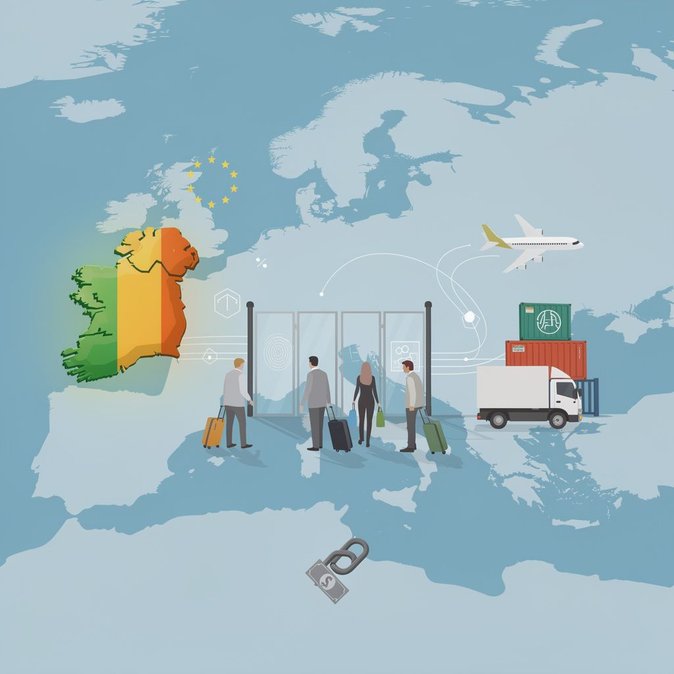
From 1 July to 31 December 2026, Ireland will hold the rotating Presidency of the Council of the European Union for the first time in more than a decade. A programme note released in Brussels on 30 June confirms that migration management and internal-security cooperation will be one of three flagship pillars under the motto “Ní neart go cur le chéile – Strength with Unity”. Irish ministers say they will use the six-month term to accelerate implementation of the recently adopted Pact on Migration and Asylum. Practical priorities include: 1) harmonising the new EU-wide Entry/Exit System (EES) and Eurodac biometric upgrades so that airlines and port operators can integrate passenger data in time for the 2027 summer peak; 2) creating a digital returns-management platform that all 27 Member States can plug into; and 3) stepping-up financial-crime tracing tools to disrupt the business models of migrant-smuggling networks.
Companies and individual travellers trying to stay ahead of these EU border policy changes might benefit from external visa and passport assistance. VisaHQ, for example, offers up-to-date guidance on Irish and wider Schengen entry rules, digital travel authorisations, and employer documentation services, all accessible through its Ireland portal at https://www.visahq.com/ireland/ Leveraging such expertise can reduce the risk of last-minute surprises as the new systems come online.
For corporate mobility teams the agenda matters because it will influence how quickly the EU moves from legacy passport-stamp controls to fully digital border records. Irish officials have already floated the idea of a phased “soft-launch” for EES at Dublin Airport and the country’s ferry ports during the Presidency, giving carriers and employers a window to iron-out IT bugs before fines for non-compliance bite. The Department of Enterprise, Trade and Employment has also indicated it will lobby partners to exempt holders of Ireland’s Critical Skills Employment Permit from double-registration under EES where advance vetting has already been performed by the Irish authorities. Immigration lawyers expect the Irish Presidency to dovetail with domestic reforms such as the International Protection Act 2026 and tougher family-reunification thresholds, signalling that Dublin wants to be seen as both pro-business and tough on irregular migration. Businesses sending staff to or through the EU in late-2026 should therefore budget for evolving carrier-API requirements and possible spot-checks on posted-workers documentation as enforcement ramps up across the bloc.

Companies and individual travellers trying to stay ahead of these EU border policy changes might benefit from external visa and passport assistance. VisaHQ, for example, offers up-to-date guidance on Irish and wider Schengen entry rules, digital travel authorisations, and employer documentation services, all accessible through its Ireland portal at https://www.visahq.com/ireland/ Leveraging such expertise can reduce the risk of last-minute surprises as the new systems come online.
For corporate mobility teams the agenda matters because it will influence how quickly the EU moves from legacy passport-stamp controls to fully digital border records. Irish officials have already floated the idea of a phased “soft-launch” for EES at Dublin Airport and the country’s ferry ports during the Presidency, giving carriers and employers a window to iron-out IT bugs before fines for non-compliance bite. The Department of Enterprise, Trade and Employment has also indicated it will lobby partners to exempt holders of Ireland’s Critical Skills Employment Permit from double-registration under EES where advance vetting has already been performed by the Irish authorities. Immigration lawyers expect the Irish Presidency to dovetail with domestic reforms such as the International Protection Act 2026 and tougher family-reunification thresholds, signalling that Dublin wants to be seen as both pro-business and tough on irregular migration. Businesses sending staff to or through the EU in late-2026 should therefore budget for evolving carrier-API requirements and possible spot-checks on posted-workers documentation as enforcement ramps up across the bloc.