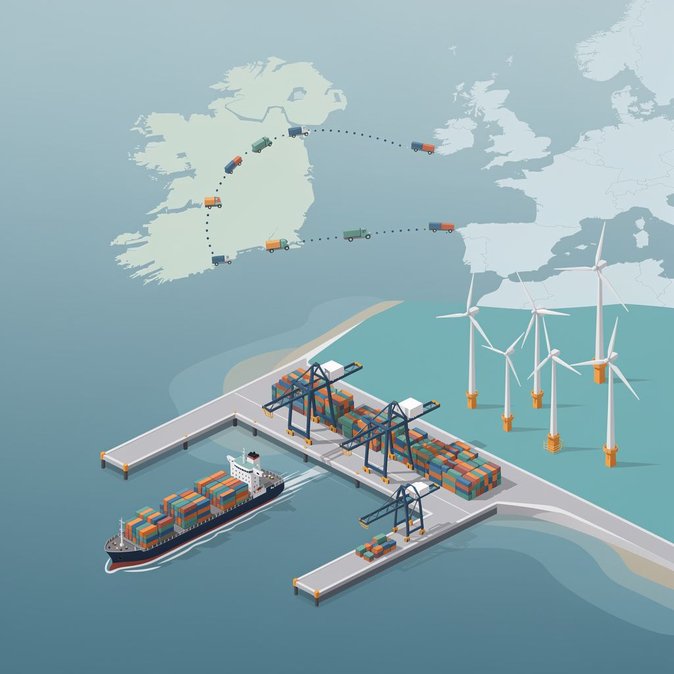
Ireland’s Department of Transport has released its long-awaited draft National Ports Policy and, for the first time, places Rosslare Europort in Co. Wexford on a par with Dublin, Cork and Shannon Foynes. Published on 3 July 2026, the document formally designates Rosslare a “Port of National Significance” – a label that drives priority access to Exchequer funding, faster planning pathways and a seat at the table when EU-wide core-network decisions are made. Why now? Since Brexit, direct roll-on/roll-off services from Rosslare to mainland EU ports have jumped from 12 to more than 60 sailings a week, diverting freight that once transited the UK ‘land-bridge’. The port has also positioned itself as a future offshore-wind marshalling hub, signing memoranda of understanding with developers targeting the Celtic and Irish Seas. Upgrading its status was therefore a key ask of local business and multinational manufacturers who depend on predictable supply chains for time-sensitive goods. Practically, the new status unlocks a multi-year capital envelope that can be used for longer berths, deeper dredging and a purpose-built customs facility sized for the EU’s forthcoming Entry-Exit System (EES). Transport officials emphasise that these works will reduce congestion at Dublin Port, offer exporters redundancy, and support Ireland’s aim to double the share of freight moved on direct EU routes by 2030. Employers with assignee traffic will welcome shorter driver turnaround times and a wider choice of ferry slots. A public consultation opened the same day and runs for eight weeks. Mobility managers, logistics providers and relocation firms are being urged to submit evidence on how port connectivity (or lack thereof) affects project timelines and cost. Final classification is expected to be confirmed in the definitive Ports Policy early in 2027, giving businesses time to align long-term transport contracts with the new status.
Source: South East Radio