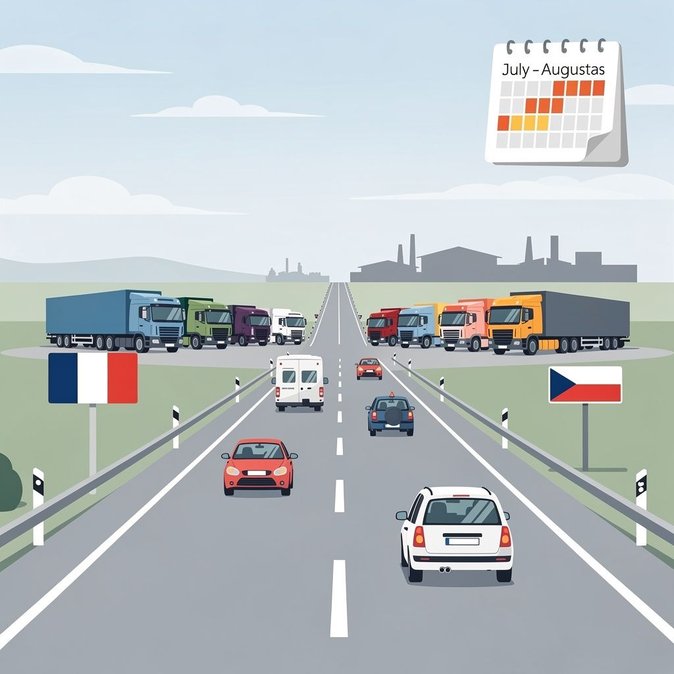
Germany’s nationwide Ferienreiseverordnung (holiday travel regulation) came into force at 07:00 on Saturday 4 July, banning heavy goods vehicles over 7.5 tonnes – including empty runs – from using 22 key Autobahns every Saturday until 31 August between 07:00 and 20:00. The restricted stretches include the A6 from Schwetzingen-Hockenheim to the Nürnberg-Süd interchange – the primary long-haul corridor linking Bavaria with the Czech D5 motorway to Plzeň and Prague. For Czech exporters and logistics providers the ban means weekend departures will have to reroute via the A93/A3 or delay until Saturday night, adding costs and complicating just-in-time supply chains feeding Bavaria’s automotive plants. The Czech Association of Road Transport Operators (ČESMAD Bohemia) advises dispatchers to issue double-drivers or schedule customs clearance on Fridays to avoid demurrage at the Rozvadov-Waidhaus border.
Although this is chiefly a logistics headache, the cross-border nature of the routes means drivers and accompanying technicians must still carry valid passports, Schengen visas and any special transit permits. VisaHQ’s Prague-based team can fast-track that paperwork—handling German transit visas, Czech residence documents and wider European travel formalities—so your staff spend less time waiting and more time driving. See for details on how they can assist with this and other mobility needs.
Leisure motorists benefit from lighter truck traffic, but police warn that congestion may shift to border parking areas as drivers wait out the ban. The Czech Highway Directorate has opened temporary rest-areas on D5 kilometres 30 and 75 to prevent hard-shoulder parking inside Czech territory. Companies relying on weekend courier services into Germany – notably e-commerce fulfilment centres around Cheb – are encouraging customers to shift to Friday pickups. Freight forwarder Dachser Czech Republic estimates that door-to-door lead times for Prague-Frankfurt pallet shipments will increase by up to 12 hours during July and August unless shippers pay priority surcharges. Because the Czech Republic does not impose equivalent Saturday bans, officials do not expect reciprocal restrictions, but are monitoring whether diverted traffic will cause weekday peaks on Czech motorways once drivers try to make up lost hours.
Although this is chiefly a logistics headache, the cross-border nature of the routes means drivers and accompanying technicians must still carry valid passports, Schengen visas and any special transit permits. VisaHQ’s Prague-based team can fast-track that paperwork—handling German transit visas, Czech residence documents and wider European travel formalities—so your staff spend less time waiting and more time driving. See for details on how they can assist with this and other mobility needs.
Leisure motorists benefit from lighter truck traffic, but police warn that congestion may shift to border parking areas as drivers wait out the ban. The Czech Highway Directorate has opened temporary rest-areas on D5 kilometres 30 and 75 to prevent hard-shoulder parking inside Czech territory. Companies relying on weekend courier services into Germany – notably e-commerce fulfilment centres around Cheb – are encouraging customers to shift to Friday pickups. Freight forwarder Dachser Czech Republic estimates that door-to-door lead times for Prague-Frankfurt pallet shipments will increase by up to 12 hours during July and August unless shippers pay priority surcharges. Because the Czech Republic does not impose equivalent Saturday bans, officials do not expect reciprocal restrictions, but are monitoring whether diverted traffic will cause weekday peaks on Czech motorways once drivers try to make up lost hours.