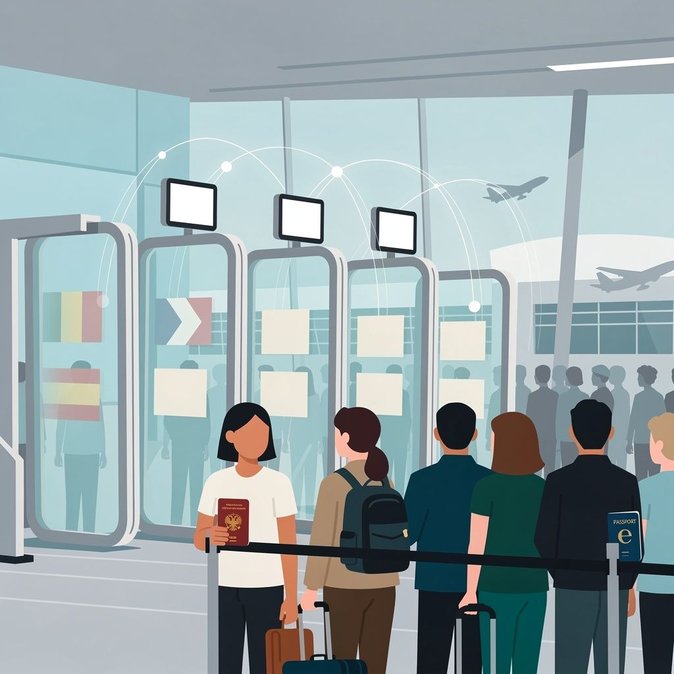
Václav Havel Airport Prague has quietly rolled out a software update to its automated border-control e-Gate system that replaces the small national flags that once appeared beside each country name with a plain, text-only list of ISO codes. Airport spokesperson Denisa Hejtmánková confirmed to Taiwan’s CNA news agency on 4 July that the change is purely cosmetic: all nationalities that were previously eligible for the fast-track electronic gates— including holders of Taiwanese, British and Australian passports—remain eligible under the same conditions. The update is part of a broader European effort to standardise user interfaces ahead of the Entry/Exit System (EES) launch, which will require non-EU short-stay visitors to register fingerprints and facial images when they cross an external Schengen border. Prague Airport began testing its upgraded e-Gates last month to ensure a seamless switchover once EES goes live EU-wide in autumn 2026. Removing flags avoids political sensitivities (for example the use of the ROC flag for Taiwan) and eliminates translation issues that slowed software certification, officials said. For business travellers the change is largely symbolic, but the underlying upgrade matters: the airport has expanded the number of e-Gate lanes from 18 to 26 and installed new biometric kiosks in the arrivals hall. According to the Czech Police Foreigners’ Service, these additions will raise hourly throughput by roughly 30 %, reducing peak-summer queue times that recently exceeded 45 minutes. Companies moving staff in and out of the Czech Republic should remind assignees to travel with a biometric passport valid for at least three months beyond their intended stay, as manual booths may become significantly slower once EES is active. The airport is also working with the Ministry of the Interior to extend e-Gate access to select third-country nationals who hold Czech long-term residence permits — a measure already available in Germany and Austria. If approved, Blue-Card and Intra-Company Transfer permit holders would be able to use the automated lanes by December, further speeding up corporate mobility. In practical terms, travellers will notice only that the familiar rows of small flags have vanished. “The eligibility rules have not changed, just the graphics,” Hejtmánková stressed. But for mobility managers the message is clear: Prague is pressing ahead with technology upgrades that will shape how quickly employees can enter and exit the country in the post-EES era.
Source: Focus Taiwan / CNA