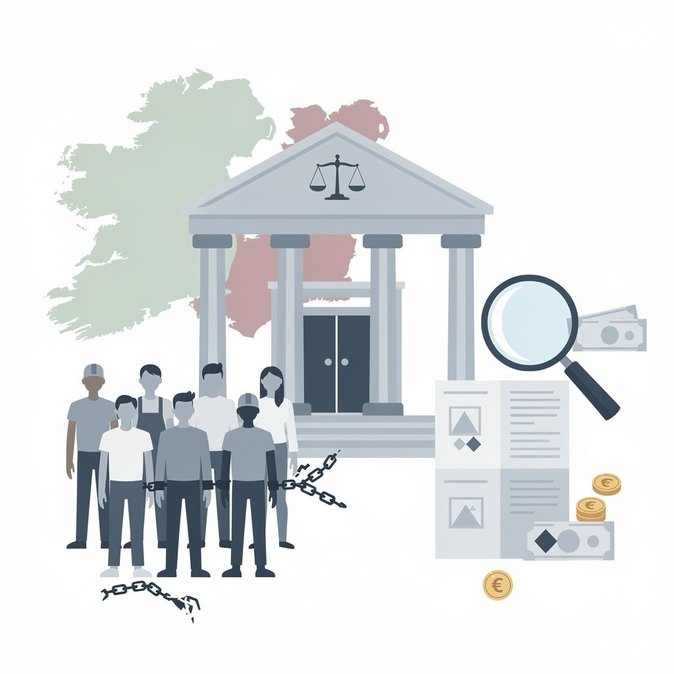
Ireland has recorded a watershed moment in its fight against human trafficking with the country’s first convictions for labour exploitation. On 3 July 2026 the Dublin Circuit Criminal Court sentenced two Latvian nationals resident in Ireland to 13 and 11 years’ imprisonment, respectively, for trafficking, money-laundering and forgery offences committed between December 2020 and October 2023.
For companies and individuals navigating Ireland’s immigration landscape—whether hiring foreign workers lawfully or securing the correct permits—VisaHQ offers streamlined visa and document-processing support. Its dedicated Ireland portal provides up-to-date requirement tracking, application management and expert guidance, reducing the administrative risks that traffickers so often exploit.
The pair lured seven vulnerable adults from Latvia with promises of well-paid jobs and accommodation but instead confiscated their identity documents, channelled their wages through shell firms and subjected them to harsh living conditions while transporting them to multiple worksites across Ireland and Northern Ireland. The convictions were the culmination of a three-year joint investigation team (JIT) coordinated by Eurojust and supported by Europol. The JIT framework allowed Gardaí, the Latvian State Police and prosecutors in both countries to share evidence, execute European Investigation Orders and conduct simultaneous searches. Eurojust experts also helped resolve conflicting jurisdictional issues, while Europol analysts mapped the financial flows that revealed a €750,000 profit from the exploitation. For employers operating in Ireland, the case is a stark reminder of the compliance obligations that accompany the state’s liberal employment-permit regime. Labour inspectors are expected to step up unannounced site visits this summer, and companies engaging recruitment agencies have been advised to carry out enhanced due-diligence checks on agency licences, wage-payment practices and accommodation standards. Legal commentators note that Irish courts can now point to substantial custodial sentences as a precedent, increasing the deterrent effect. From a mobility perspective, the ruling may encourage more victims to come forward, particularly among posted and intra-EU migrant workers who fear immigration repercussions. The Department of Enterprise, Trade and Employment (DETE) and the Workplace Relations Commission are preparing an information campaign in Latvian, Lithuanian and Polish to explain workers’ rights and safe-reporting channels. Businesses that rely on seasonal or outsourced labour should review supply-chain clauses to ensure zero-tolerance of forced labour, as the EU Corporate Sustainability Due Diligence Directive will make such abuses costly. Finally, the cross-border nature of the crime highlights the importance of cooperation between the Common Travel Area (CTA) partners. The UK’s upcoming digital visa platform will give Gardaí and UK Border Force real-time visibility of suspects’ immigration status—another tool likely to be brought to bear in future trafficking investigations.
For companies and individuals navigating Ireland’s immigration landscape—whether hiring foreign workers lawfully or securing the correct permits—VisaHQ offers streamlined visa and document-processing support. Its dedicated Ireland portal provides up-to-date requirement tracking, application management and expert guidance, reducing the administrative risks that traffickers so often exploit.
The pair lured seven vulnerable adults from Latvia with promises of well-paid jobs and accommodation but instead confiscated their identity documents, channelled their wages through shell firms and subjected them to harsh living conditions while transporting them to multiple worksites across Ireland and Northern Ireland. The convictions were the culmination of a three-year joint investigation team (JIT) coordinated by Eurojust and supported by Europol. The JIT framework allowed Gardaí, the Latvian State Police and prosecutors in both countries to share evidence, execute European Investigation Orders and conduct simultaneous searches. Eurojust experts also helped resolve conflicting jurisdictional issues, while Europol analysts mapped the financial flows that revealed a €750,000 profit from the exploitation. For employers operating in Ireland, the case is a stark reminder of the compliance obligations that accompany the state’s liberal employment-permit regime. Labour inspectors are expected to step up unannounced site visits this summer, and companies engaging recruitment agencies have been advised to carry out enhanced due-diligence checks on agency licences, wage-payment practices and accommodation standards. Legal commentators note that Irish courts can now point to substantial custodial sentences as a precedent, increasing the deterrent effect. From a mobility perspective, the ruling may encourage more victims to come forward, particularly among posted and intra-EU migrant workers who fear immigration repercussions. The Department of Enterprise, Trade and Employment (DETE) and the Workplace Relations Commission are preparing an information campaign in Latvian, Lithuanian and Polish to explain workers’ rights and safe-reporting channels. Businesses that rely on seasonal or outsourced labour should review supply-chain clauses to ensure zero-tolerance of forced labour, as the EU Corporate Sustainability Due Diligence Directive will make such abuses costly. Finally, the cross-border nature of the crime highlights the importance of cooperation between the Common Travel Area (CTA) partners. The UK’s upcoming digital visa platform will give Gardaí and UK Border Force real-time visibility of suspects’ immigration status—another tool likely to be brought to bear in future trafficking investigations.