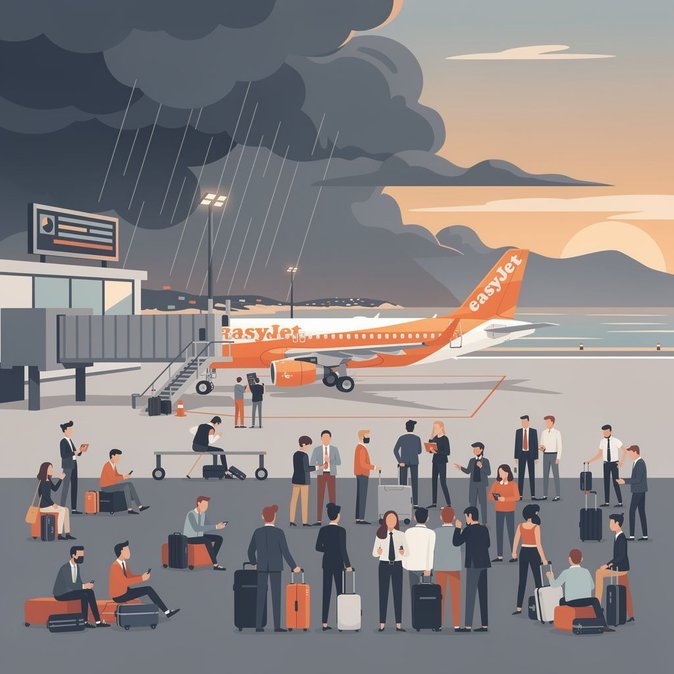
What began as a routine 45-minute weather delay on EasyJet flight EZS1359 from Geneva to Ajaccio on 1 July spiralled into a five-hour stand-off that culminated in the captain scrubbing the service entirely. La Dépêche’s 6 July follow-up report reveals that storm-related congestion over northern Italy repeatedly postponed the Airbus A320’s take-off slot.
Tempers flared when three passengers insisted on deplaning just as the crew finally secured clearance, triggering mandatory baggage reconciliation protocols and, ultimately, cancellation. The saga left 150 passengers—many Swiss holiday-makers and Corsican residents returning from work trips—stranded at Geneva Airport well after 19:30. Several eyewitnesses described heated exchanges on board; cabin crew called airport police to prevent physical altercations as frustrated travellers jeered the trio who walked off. EasyJet has offered rebooking "in the coming days" and meal vouchers, but consumer-rights groups point out that under EU Reg 261/2004, each traveller may claim up to €250 in compensation because the cancellation occurred after boarding was complete and was not directly caused by extraordinary circumstances.
Amid the scramble for alternative flights, many travelers also discovered that backup routings via North African or Balkan hubs can require transit or entry visas they hadn’t originally planned for. VisaHQ’s Swiss portal lets passengers check those requirements in real time and file expedited electronic applications within minutes—an especially useful safety net when cancellations hit at the height of the holiday rush.
The incident highlights the operational tightrope airlines walk during Europe’s increasingly storm-prone summers, where a single late-running slot can unravel duty-time limits and airport-curfew compliance. For corporate mobility planners the key lesson is to build redundancy into itineraries involving secondary Mediterranean destinations with limited same-day alternatives. Travel-risk teams also note the personal-safety dimension: prolonged confinement in hot cabins can spark confrontations, so employees should be briefed on de-escalation tactics and the consequences of leaving the aircraft against crew instructions. Geneva Airport told Global Mobility News that it will review its passenger-communication protocols after criticism that real-time updates were sparse once boarding had closed. The airport handled more than 9 % extra traffic in June compared with 2025, straining stand availability during irregular-operations events.
Tempers flared when three passengers insisted on deplaning just as the crew finally secured clearance, triggering mandatory baggage reconciliation protocols and, ultimately, cancellation. The saga left 150 passengers—many Swiss holiday-makers and Corsican residents returning from work trips—stranded at Geneva Airport well after 19:30. Several eyewitnesses described heated exchanges on board; cabin crew called airport police to prevent physical altercations as frustrated travellers jeered the trio who walked off. EasyJet has offered rebooking "in the coming days" and meal vouchers, but consumer-rights groups point out that under EU Reg 261/2004, each traveller may claim up to €250 in compensation because the cancellation occurred after boarding was complete and was not directly caused by extraordinary circumstances.
Amid the scramble for alternative flights, many travelers also discovered that backup routings via North African or Balkan hubs can require transit or entry visas they hadn’t originally planned for. VisaHQ’s Swiss portal lets passengers check those requirements in real time and file expedited electronic applications within minutes—an especially useful safety net when cancellations hit at the height of the holiday rush.
The incident highlights the operational tightrope airlines walk during Europe’s increasingly storm-prone summers, where a single late-running slot can unravel duty-time limits and airport-curfew compliance. For corporate mobility planners the key lesson is to build redundancy into itineraries involving secondary Mediterranean destinations with limited same-day alternatives. Travel-risk teams also note the personal-safety dimension: prolonged confinement in hot cabins can spark confrontations, so employees should be briefed on de-escalation tactics and the consequences of leaving the aircraft against crew instructions. Geneva Airport told Global Mobility News that it will review its passenger-communication protocols after criticism that real-time updates were sparse once boarding had closed. The airport handled more than 9 % extra traffic in June compared with 2025, straining stand availability during irregular-operations events.