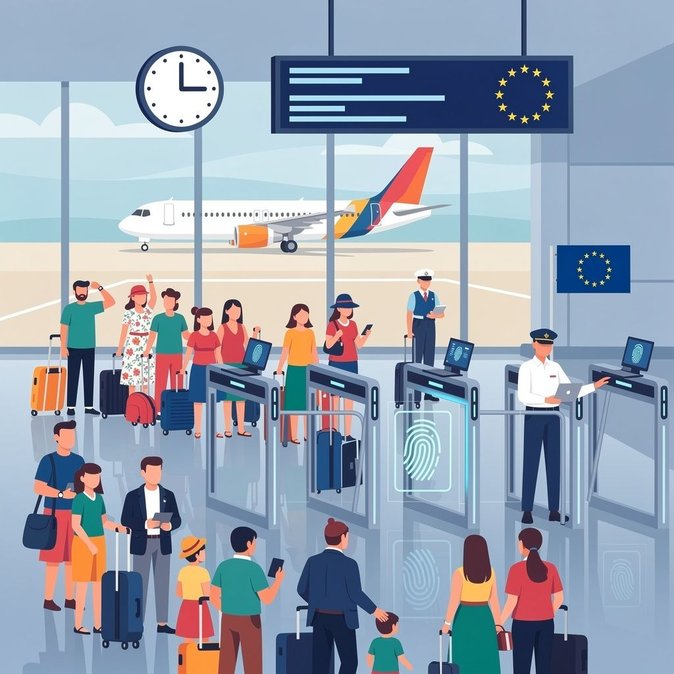
Budget carrier Ryanair has fired a fresh warning shot at European governments, claiming many airports are still unprepared for the EU’s new biometric Entry/Exit System (EES) that became fully operational in April. In comments reported by The Independent on 6 July, the airline listed Paris-Beauvais among seven airports—including Tenerife South, Palma, Alicante, Málaga, Milan Bergamo and Kraków—where it expects long queues for non-EU travellers this summer. Under EES every non-EU visitor must provide fingerprints and a facial scan at their first Schengen border crossing; the data are stored for three years.
If you’re unsure how the new biometric rules might affect your next trip, VisaHQ can help. The company’s France page offers up-to-date guidance on Schengen entry requirements, step-by-step support for visa and passport renewals, and alert services that flag operational changes like EES roll-outs—making it easier for both leisure and corporate travellers to stay compliant.
At smaller, high-volume airports such as Paris-Beauvais—used heavily by low-cost carriers and weekend city-breakers—the switch from a two-second passport stamp to a 90-120 second biometric enrolment has already produced hour-long waits. Ryanair argues that staffing levels, the number of kiosks and IT resilience are “far below what peak-season volumes require”. France’s own border-police union backs that assessment: in testimony to the Senate last week it put first-time enrolment at “roughly six times longer than manual stamping”, cautioning that bottlenecks at provincial airports could spill onto the tarmac during August. Airline and airport associations A4E, ACI Europe and IATA have formally asked Brussels for the power to suspend EES on days when passenger throughput exceeds processing capacity—but, so far, the Commission is standing firm. For corporate mobility teams the practical fallout is clear. Travellers who normally breeze through Beauvais on a Monday-morning flight from London now need to budget up to an extra hour to clear immigration, jeopardising same-day meetings in the Paris region. HR teams relocating assignees should ensure newcomers understand the one-time biometric capture requirement and the importance of arriving extra-early for the outbound leg until volumes stabilise. Ryanair’s call for a September postponement looks unlikely to succeed, but pressure is mounting for at least a limited derogation during the July–August peak. In the meantime, airlines are updating customer advisories to recommend arriving a full three hours before departure, and some carriers are trialling dedicated ‘EES help desks’ at French regional gateways.
If you’re unsure how the new biometric rules might affect your next trip, VisaHQ can help. The company’s France page offers up-to-date guidance on Schengen entry requirements, step-by-step support for visa and passport renewals, and alert services that flag operational changes like EES roll-outs—making it easier for both leisure and corporate travellers to stay compliant.
At smaller, high-volume airports such as Paris-Beauvais—used heavily by low-cost carriers and weekend city-breakers—the switch from a two-second passport stamp to a 90-120 second biometric enrolment has already produced hour-long waits. Ryanair argues that staffing levels, the number of kiosks and IT resilience are “far below what peak-season volumes require”. France’s own border-police union backs that assessment: in testimony to the Senate last week it put first-time enrolment at “roughly six times longer than manual stamping”, cautioning that bottlenecks at provincial airports could spill onto the tarmac during August. Airline and airport associations A4E, ACI Europe and IATA have formally asked Brussels for the power to suspend EES on days when passenger throughput exceeds processing capacity—but, so far, the Commission is standing firm. For corporate mobility teams the practical fallout is clear. Travellers who normally breeze through Beauvais on a Monday-morning flight from London now need to budget up to an extra hour to clear immigration, jeopardising same-day meetings in the Paris region. HR teams relocating assignees should ensure newcomers understand the one-time biometric capture requirement and the importance of arriving extra-early for the outbound leg until volumes stabilise. Ryanair’s call for a September postponement looks unlikely to succeed, but pressure is mounting for at least a limited derogation during the July–August peak. In the meantime, airlines are updating customer advisories to recommend arriving a full three hours before departure, and some carriers are trialling dedicated ‘EES help desks’ at French regional gateways.