The European Parliament in Strasbourg on 7 July approved a sweeping revision of EU Regulation 261/2004, the rulebook that governs compensation for flight delays and cancellations. The reform – championed by Cypriot MEPs across party lines – plugs long-criticised loopholes, caps ‘hidden’ surcharges, and obliges airlines to seat children under 14 next to accompanying adults at no extra cost. Crucially, the regulation now spells out that extraordinary circumstances must be interpreted narrowly, making it harder for carriers to dodge payouts. Travel-tech platforms will gain direct API access to airline systems so that disrupted passengers can rebook themselves on the next available service, even with a competitor.
For Cyprus – an island whose 11.7 million annual passengers have no rail or land alternatives – the changes are more than a consumer-rights upgrade. Tour operators told Politis that upfront cost transparency should lower the “resort surcharge” that charter airlines traditionally add for captive island destinations. HR managers in the booming ICT sector say clearer rules will reduce travel-budget contingencies they have had to build into assignee packages since the chaotic 2024 and 2025 summer seasons.
Whether you're a traveller trying to gauge entry requirements on short notice or an employer arranging last-minute mobility for staff, VisaHQ can cut through the red tape. The platform’s Cyprus portal offers real-time visa guidance and application handling for more than 200 destinations, helping passengers avoid border-control surprises and fully benefit from the EU’s strengthened flight-rights regime.
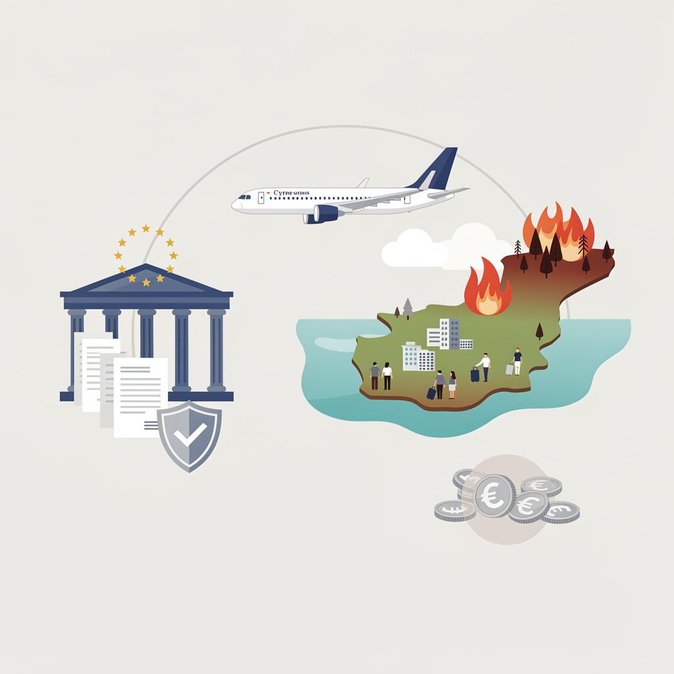
The same vote unlocked €9.21 million from the EU Solidarity Fund to cover reconstruction of schools, clinics and roads damaged in the devastating Limassol and Paphos wildfires of July 2025. Although not strictly mobility-related, the grant is tied to the EU Civil Protection Mechanism, under which 777 firefighters from 14 member states – many of them flown through Larnaca – will be pre-positioned on the island this summer. Civil-aviation officials say the seasonal influx of specialised personnel requires fast-track border-control lanes and dedicated parking stands for water-bombers at Paphos airport.
Legal teams now advise multinationals with regional hubs in Nicosia to review staff-handbook language on flight disruption. From March 2027, companies that charter aircraft for incentive trips will also become jointly liable for compensation unless they ensure the carrier has an EU Air-Operator Certificate. “The days of cheap wet-leases from obscure third countries are numbered,” says Maria Andreou, aviation counsel at Chrysostomides & Co. A public information campaign led by the Ministry of Transport will roll out at Larnaca and Paphos in August, complete with QR codes that link travellers to a multilingual compensation calculator.
In the medium term, analysts expect the tougher regime to accelerate Cyprus’s push to diversify beyond low-cost point-to-point traffic. Flag-carrier Cyprus Airways has already hinted it will use the new rules as a marketing tool to position its planned 2027 network expansion – including nonstop service to New York – as a ‘premium-reliable’ alternative in the east-Mediterranean market.
For Cyprus – an island whose 11.7 million annual passengers have no rail or land alternatives – the changes are more than a consumer-rights upgrade. Tour operators told Politis that upfront cost transparency should lower the “resort surcharge” that charter airlines traditionally add for captive island destinations. HR managers in the booming ICT sector say clearer rules will reduce travel-budget contingencies they have had to build into assignee packages since the chaotic 2024 and 2025 summer seasons.
Whether you're a traveller trying to gauge entry requirements on short notice or an employer arranging last-minute mobility for staff, VisaHQ can cut through the red tape. The platform’s Cyprus portal offers real-time visa guidance and application handling for more than 200 destinations, helping passengers avoid border-control surprises and fully benefit from the EU’s strengthened flight-rights regime.
The same vote unlocked €9.21 million from the EU Solidarity Fund to cover reconstruction of schools, clinics and roads damaged in the devastating Limassol and Paphos wildfires of July 2025. Although not strictly mobility-related, the grant is tied to the EU Civil Protection Mechanism, under which 777 firefighters from 14 member states – many of them flown through Larnaca – will be pre-positioned on the island this summer. Civil-aviation officials say the seasonal influx of specialised personnel requires fast-track border-control lanes and dedicated parking stands for water-bombers at Paphos airport.
Legal teams now advise multinationals with regional hubs in Nicosia to review staff-handbook language on flight disruption. From March 2027, companies that charter aircraft for incentive trips will also become jointly liable for compensation unless they ensure the carrier has an EU Air-Operator Certificate. “The days of cheap wet-leases from obscure third countries are numbered,” says Maria Andreou, aviation counsel at Chrysostomides & Co. A public information campaign led by the Ministry of Transport will roll out at Larnaca and Paphos in August, complete with QR codes that link travellers to a multilingual compensation calculator.
In the medium term, analysts expect the tougher regime to accelerate Cyprus’s push to diversify beyond low-cost point-to-point traffic. Flag-carrier Cyprus Airways has already hinted it will use the new rules as a marketing tool to position its planned 2027 network expansion – including nonstop service to New York – as a ‘premium-reliable’ alternative in the east-Mediterranean market.