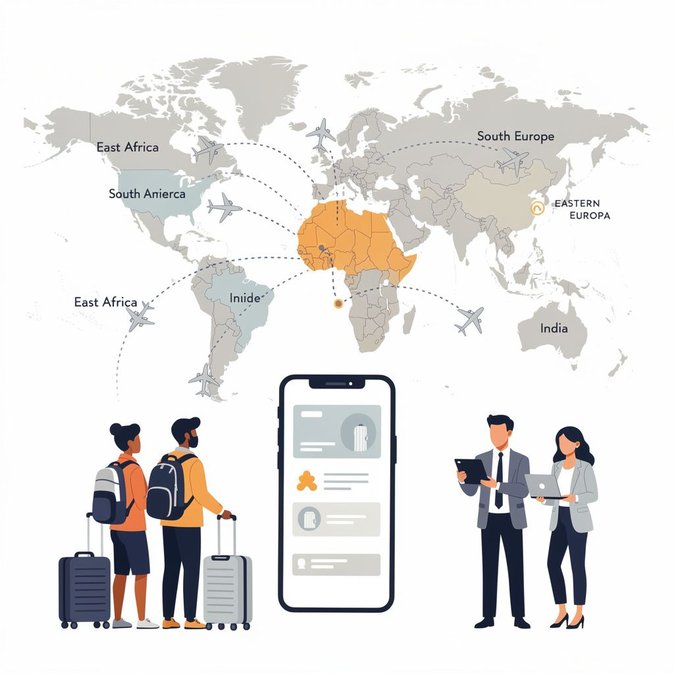
The Ministry of Home Affairs confirmed on 6 July that citizens of 25 additional countries will be able to apply for Indian tourist and business e-Visas from 15 August 2026. New markets span Africa, Latin America and Eastern Europe—including Kenya, Colombia, Serbia, Ecuador, Tanzania and Guatemala—bringing total e-Visa-eligible nationalities to 188. Processing times and fees remain unchanged at three-to-five working days and US $25 for a 30-day permit.
Companies or individual travellers looking for a streamlined way to secure the new Indian e-Visa can turn to VisaHQ’s online platform; the service provides step-by-step application support, document checking and real-time status tracking in one convenient dashboard, making it easier for mobility teams and tourists alike to navigate the expanded eligibility landscape.
Officials told Reuters that the expansion aims to double annual e-Visa issuances from 1.8 million in 2025 to over 3 million by year-end 2026, supporting India’s post-G20 tourism-and-investment strategy. For corporate mobility teams, the change removes the need for consular appointments when sending specialists from the newly eligible countries on short-term projects, training or sales visits. While the e-Visa platform now covers most major emerging markets, Pakistan and China remain excluded due to security and reciprocity concerns. Government sources hinted that up to ten more African states could join by December if the current roll-out proceeds smoothly. Travel advisers note that applicants should still carry printed Electronic Travel Authorisation copies and proof of onward travel. Airlines must check e-Visa approvals prior to boarding, and travellers may be denied boarding if the ETA status has not migrated from “Granted” to “Confirmed” in the immigration system. Companies are advised to refresh internal mobility guidance and update country matrices before 15 August to capture the new eligibility list.
Companies or individual travellers looking for a streamlined way to secure the new Indian e-Visa can turn to VisaHQ’s online platform; the service provides step-by-step application support, document checking and real-time status tracking in one convenient dashboard, making it easier for mobility teams and tourists alike to navigate the expanded eligibility landscape.
Officials told Reuters that the expansion aims to double annual e-Visa issuances from 1.8 million in 2025 to over 3 million by year-end 2026, supporting India’s post-G20 tourism-and-investment strategy. For corporate mobility teams, the change removes the need for consular appointments when sending specialists from the newly eligible countries on short-term projects, training or sales visits. While the e-Visa platform now covers most major emerging markets, Pakistan and China remain excluded due to security and reciprocity concerns. Government sources hinted that up to ten more African states could join by December if the current roll-out proceeds smoothly. Travel advisers note that applicants should still carry printed Electronic Travel Authorisation copies and proof of onward travel. Airlines must check e-Visa approvals prior to boarding, and travellers may be denied boarding if the ETA status has not migrated from “Granted” to “Confirmed” in the immigration system. Companies are advised to refresh internal mobility guidance and update country matrices before 15 August to capture the new eligibility list.