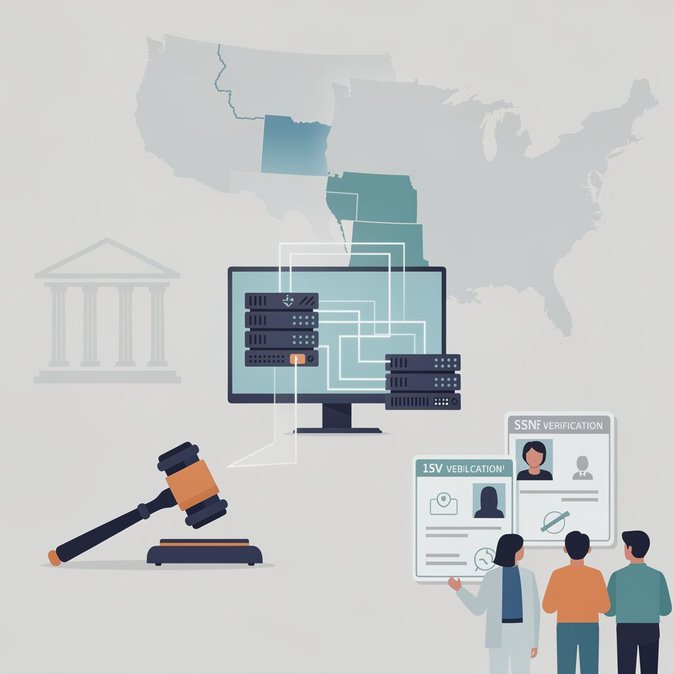
A federal judge in Florida issued a sweeping order on July 7 compelling the Department of Homeland Security (DHS) to immediately switch back on two high-profile upgrades to the Systematic Alien Verification for Entitlements (SAVE) program—bulk-upload capability and Social-Security-number (SSN) searches—that the agency had abruptly disabled last month. The SAVE database allows state and local governments to verify a person’s immigration status for benefits eligibility, voter-registration maintenance, professional-license issuance and, increasingly, employment screening.
Organizations looking for additional assurance that visa documents and immigration statuses are processed correctly can turn to VisaHQ’s online platform. VisaHQ offers real-time tracking, compliance reminders, and expert support for U.S. visa and work-authorization applications, helping companies avoid delays when government tools like SAVE are in flux. Explore how the service can complement your mobility program at
Under a 2025 court settlement with Florida, Ohio and Iowa, DHS had modernised the system so that states could upload thousands of records at once and query immigration status by using full or partial SSNs instead of the less common “A-number.” Those tools went live in December 2025, but DHS shut them down on 24 June 2026 after a Washington, D.C., court said the changes violated the Privacy Act and the Social Security Act. U.S. District Judge T. Kent Wetherell II rejected DHS’s position that the agency was trapped between conflicting court orders, calling the argument “frivolous.” He held that the states face irreparable harm if they cannot vet voter rolls or license applicants efficiently, and he openly disagreed with the D.C. court’s reading of federal privacy law. DHS must now file a compliance report within seven days while it decides whether to appeal.
Why this matters: For corporate mobility managers, the ruling is more than an election-integrity skirmish. Many state licensing boards use SAVE to clear foreign engineers, nurses and other skilled professionals before granting credentials that underpin U.S. assignments. If the enhanced functions remain active, employers can expect faster onboarding and fewer manual document requests. Conversely, another shutdown could trigger fresh backlogs just as fall hiring ramps up.
Practical take-aways:
• Multistate employers should confirm whether licensing agencies in their footprint rely on SAVE and monitor any processing pauses.
• Companies using SAVE directly—common in higher education and health care—should verify that bulk files are once again being accepted.
• If DHS appeals, expect more litigation-driven whiplash; build extra time into start-date planning for foreign staff who require state authorisation.
Organizations looking for additional assurance that visa documents and immigration statuses are processed correctly can turn to VisaHQ’s online platform. VisaHQ offers real-time tracking, compliance reminders, and expert support for U.S. visa and work-authorization applications, helping companies avoid delays when government tools like SAVE are in flux. Explore how the service can complement your mobility program at
Under a 2025 court settlement with Florida, Ohio and Iowa, DHS had modernised the system so that states could upload thousands of records at once and query immigration status by using full or partial SSNs instead of the less common “A-number.” Those tools went live in December 2025, but DHS shut them down on 24 June 2026 after a Washington, D.C., court said the changes violated the Privacy Act and the Social Security Act. U.S. District Judge T. Kent Wetherell II rejected DHS’s position that the agency was trapped between conflicting court orders, calling the argument “frivolous.” He held that the states face irreparable harm if they cannot vet voter rolls or license applicants efficiently, and he openly disagreed with the D.C. court’s reading of federal privacy law. DHS must now file a compliance report within seven days while it decides whether to appeal.
Why this matters: For corporate mobility managers, the ruling is more than an election-integrity skirmish. Many state licensing boards use SAVE to clear foreign engineers, nurses and other skilled professionals before granting credentials that underpin U.S. assignments. If the enhanced functions remain active, employers can expect faster onboarding and fewer manual document requests. Conversely, another shutdown could trigger fresh backlogs just as fall hiring ramps up.
Practical take-aways:
• Multistate employers should confirm whether licensing agencies in their footprint rely on SAVE and monitor any processing pauses.
• Companies using SAVE directly—common in higher education and health care—should verify that bulk files are once again being accepted.
• If DHS appeals, expect more litigation-driven whiplash; build extra time into start-date planning for foreign staff who require state authorisation.