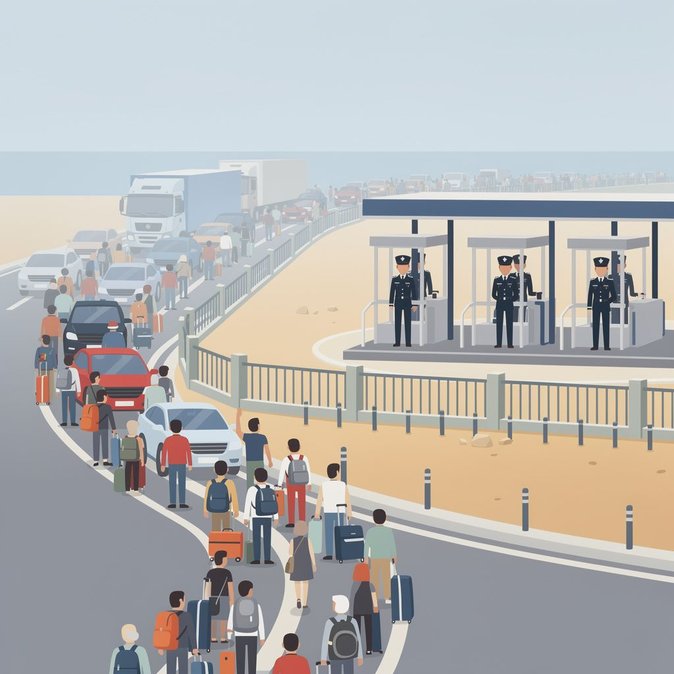
Only three months after Spain switched off passport stamps and switched on the EU’s new biometric Entry/Exit System (EES), Brussels has quietly admitted that the next stage in the bloc’s smart-border plan is running late. EU officials told the Financial Times that the European Travel Information and Authorisation System (ETIAS) – a €20 online permit that visa-free travellers will need before flying to Spain or any other Schengen country – will “almost certainly” miss its October-2026 start date and slip to 2027. For Spanish airports, the reprieve is welcome. Since EES became fully operational in April, queues of up to two hours have been reported at Madrid-Barajas, Barcelona-El Prat and Málaga-Costa del Sol as non-EU passengers line up for fingerprint and facial-scan kiosks that are often understaffed. Industry bodies ACI Europe, Airlines for Europe and IATA warned President von der Leyen on 1 July that EES had reached a “critical point” and asked for a summer suspension – a request the Commission rejected. Adding ETIAS checks on top of the current congestion, Spanish carriers argue, risked “chaos” during the August peak. EU-LISA, the agency that builds the bloc’s large IT systems, says software bugs and the need to “stabilise EES first” leave “no viable path” to a 2026 go-live. Although the official ETIAS website still shows Q4-2026, internal planning documents now cite 2027, according to the leak. When ETIAS does arrive, it will function much like the US ESTA: travellers from 60 visa-waiver countries – the UK, US, Australia and most of Latin America among them – will complete a web form, pay €20 and receive a three-year travel pass linked to their passport. For Spanish tourism operators, the delay buys time to prepare booking flows and customer messaging. Tour groups that sell combined Portugal-Spain circuits, for example, feared thousands of late-season cancellations by British and American visitors unfamiliar with the new permit. Airlines gain up to a year to integrate ETIAS “OK-to-fly” signals into check-in systems and to train gate agents. The Spanish government, meanwhile, can focus resources on fixing the teething problems of EES – from installing more self-service kiosks to increasing National Police staffing at passport control. Practical tip: companies moving staff to Spain in late-2026 should not assume ETIAS is required, but mobility teams should monitor Commission communiqués and factor a €20 cost and 96-hour processing window into 2027 itineraries. Travellers must also remember that ETIAS is separate from Schengen short-stay rules – the 90/180-day limit and proof-of-funds checks at the border will still apply even after the authorisation is approved.
Source: Euronews