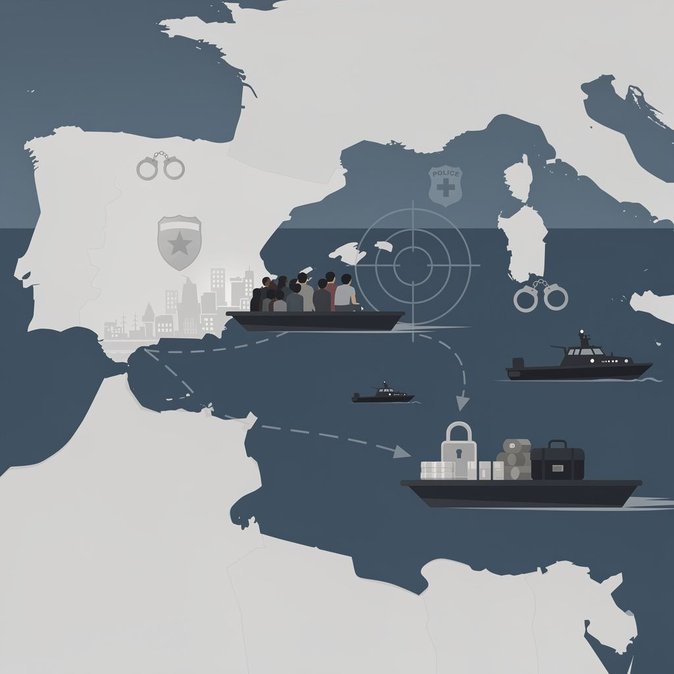
Spain’s National Police, working with counterparts in Belgium and France and coordinated by Europol and Eurojust, announced on 8 July the dismantling of a transnational network that smuggled hundreds of Algerian migrants – and cocaine shipments on the return leg – across the Mediterranean. Sixteen suspects were arrested in Spain and four in Belgium; five are already in pre-trial detention. According to investigators, the gang charged between €8,000 and €10,000 per person for the perilous crossing in high-powered RIBs. The same boats reportedly carried MDMA and cocaine back to Algeria, generating an estimated €8 million in combined human-smuggling and narcotics profits. The probe began after a 2022 shipwreck in which 12 migrants drowned off the Valencian coast, an incident that highlighted the lethal risks of the so-called ‘Algerian route’ to mainland Spain. Raids in Alicante, Madrid, Murcia and Vitoria uncovered two fast boats, a stash of 27 fuel ‘jerrycans’, firearms, €12,430 in cash and over a kilogram of MDMA powder. Belgian police seized additional weapons and documents linking the Spanish crew to a family-run clan based in Ghent that allegedly coordinated drug pickups in northern Europe. Europol analysts believe the organisation offered a “premium service” to Algerian clients seeking a faster alternative to the Canary Islands route. For Spain, the bust illustrates a shift in irregular-migration patterns in 2026. Interior Ministry statistics show arrivals to the Canary Islands down 67 % year-on-year, while mainland landings along the Levante have inched up. Corporate security managers moving staff or sensitive cargo through Alicante and Murcia ports should note the renewed law-enforcement focus on clandestine docks and possible checkpoint delays. The operation also underscores the growing nexus between people-smuggling and drug trafficking in the western Mediterranean. EU mobility compliance teams should ensure that any third-party logistics providers used for relocations or project shipments are vetted against the expanding Europol risk lists to avoid inadvertent complicity.
Source: Ministerio del Interior (Spain)