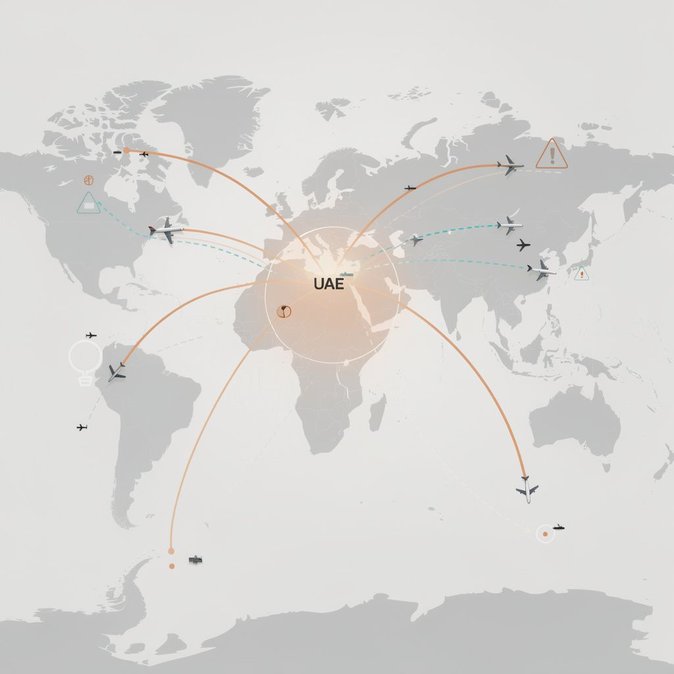
The clock has run out on the special 30-day overstay grace period the UAE introduced on 10 June for travellers stranded by this year’s regional air-space closures. At 11:59 p.m. on 9 July 2026, the exemption formally expired, bringing the normal schedule of fines and immigration penalties back into force.
Background – why the grace period was created: In late February, escalating US-Iran hostilities triggered widespread air-space shutdowns across the Gulf, forcing hundreds of commercial flights to divert or cancel. Thousands of visitors and some UAE residents suddenly found themselves unable to depart before short-term visas ran out. In March, the Federal Authority for Identity, Citizenship, Customs & Port Security (ICP) suspended overstay fines as a humanitarian measure, then in June announced a final 30-day window for people to regularise their status or leave.
What happens now: Anyone who benefited from that amnesty but has not secured a new residency or exit stamp is once again subject to normal penalties – AED 50 (≈ US $13.60) per day of overstay plus possible immigration bans.
For travelers uncertain about their next steps, VisaHQ can help streamline the paperwork: its online portal walks applicants through UAE visa requirements, document uploads, and real-time tracking—see for details.
Visa consultants tell Gulf News that typing centres processed a surge of “status-change” applications over the past week as employers rushed to convert visit visas to work permits. Dubai International Airport (DXB) also reported above-average outbound traffic on 8–9 July as visitors scrambled to depart.
Practical implications for employers and mobility teams:
• Check that assignees who entered on visit visas after the February disruptions have either exited or switched to residency.
• Expect longer queues at ICP service centres this week while late filers submit last-minute applications.
• Advise business travellers that no further blanket extensions are expected; any future disruption will be handled case-by-case.
Why it matters: The episode underscores the UAE’s willingness to introduce rapid, compassionate immigration fixes during crises – but also its determination to re-impose strict compliance once normal flight operations resume. Companies relying on frequent short-term travel should maintain real-time tracking of regional security developments and build contingency days into visa validity calculations.
Background – why the grace period was created: In late February, escalating US-Iran hostilities triggered widespread air-space shutdowns across the Gulf, forcing hundreds of commercial flights to divert or cancel. Thousands of visitors and some UAE residents suddenly found themselves unable to depart before short-term visas ran out. In March, the Federal Authority for Identity, Citizenship, Customs & Port Security (ICP) suspended overstay fines as a humanitarian measure, then in June announced a final 30-day window for people to regularise their status or leave.
What happens now: Anyone who benefited from that amnesty but has not secured a new residency or exit stamp is once again subject to normal penalties – AED 50 (≈ US $13.60) per day of overstay plus possible immigration bans.
For travelers uncertain about their next steps, VisaHQ can help streamline the paperwork: its online portal walks applicants through UAE visa requirements, document uploads, and real-time tracking—see for details.
Visa consultants tell Gulf News that typing centres processed a surge of “status-change” applications over the past week as employers rushed to convert visit visas to work permits. Dubai International Airport (DXB) also reported above-average outbound traffic on 8–9 July as visitors scrambled to depart.
Practical implications for employers and mobility teams:
• Check that assignees who entered on visit visas after the February disruptions have either exited or switched to residency.
• Expect longer queues at ICP service centres this week while late filers submit last-minute applications.
• Advise business travellers that no further blanket extensions are expected; any future disruption will be handled case-by-case.
Why it matters: The episode underscores the UAE’s willingness to introduce rapid, compassionate immigration fixes during crises – but also its determination to re-impose strict compliance once normal flight operations resume. Companies relying on frequent short-term travel should maintain real-time tracking of regional security developments and build contingency days into visa validity calculations.