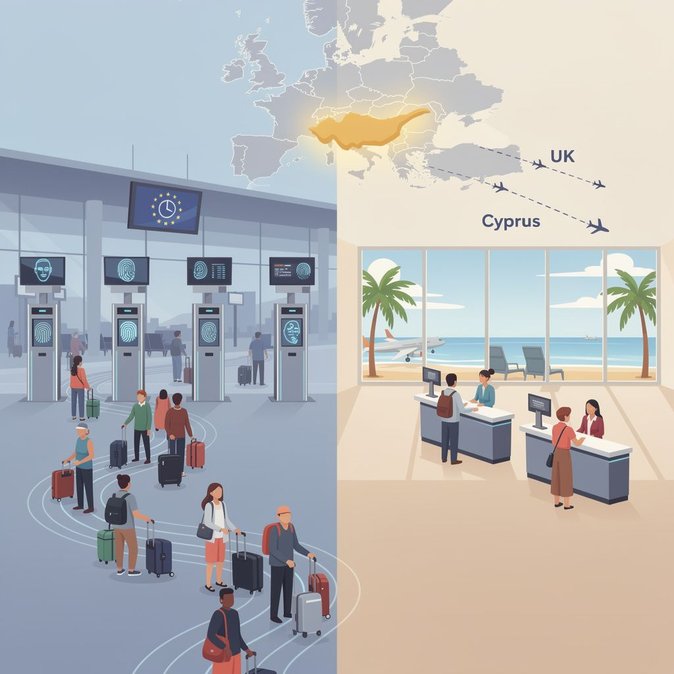
Cypriot travellers arriving at Larnaca and Paphos airports on 10 July were greeted by familiar passport booths rather than the new biometric kiosks that have paralysed several European hubs this week. The reason is simple: the Republic of Cyprus is not yet part of the Schengen Area and therefore has not deployed the EU’s long-awaited Entry/Exit System (EES). Airport sources confirmed to Phileleftheros that border processing continued as normal while passengers elsewhere in Europe faced lines of up to five hours. EES electronically records the time and place that every non-EU national enters or leaves the Schengen zone, capturing facial images and fingerprints to replace the traditional passport stamp. The system finally went live on 8 July after multiple postponements linked to technical glitches and airline lobbying. Within 48 hours, airports in Greece, Spain and Germany were reporting severe congestion, prompting ACI Europe and IATA to ask Brussels for an emergency summer suspension. The European Commission has so far refused. While Cyprus has avoided the immediate disruption, officials at the Deputy Ministry of Tourism and the Civil Aviation Department are watching closely. Nicosia has signalled its intention to join Schengen this decade, and Parliament has already approved legislation to align national databases with the Schengen Visa Information System. Once the island connects to EES, border forces will have to process roughly four million arriving Britons each year—Cyprus’ single largest tourist market—through biometric capture on first entry. Stakeholders warn that peak-season queues could become an issue unless additional e-gates and staffing are secured well in advance. For businesses, the reprieve is temporary. Multinationals moving staff through Cyprus should begin mapping travel policies to the new Schengen realities. Frequent flyers holding multiple passports may need to decide which document will be logged in EES to avoid overstaying issues. Companies should also budget for potential training and hardware costs if they rely on in-house travel desks or VIP meet-and-greet services. The government, meanwhile, must balance its ambition for deeper EU integration against the practical need to keep the island’s crucial tourism and expat channels running smoothly. In short, Cyprus has won a short-term victory by staying outside the biometric fray, but the EES clock is ticking—and every delay elsewhere in Europe offers lessons the island can ill afford to ignore.
Source: Philenews