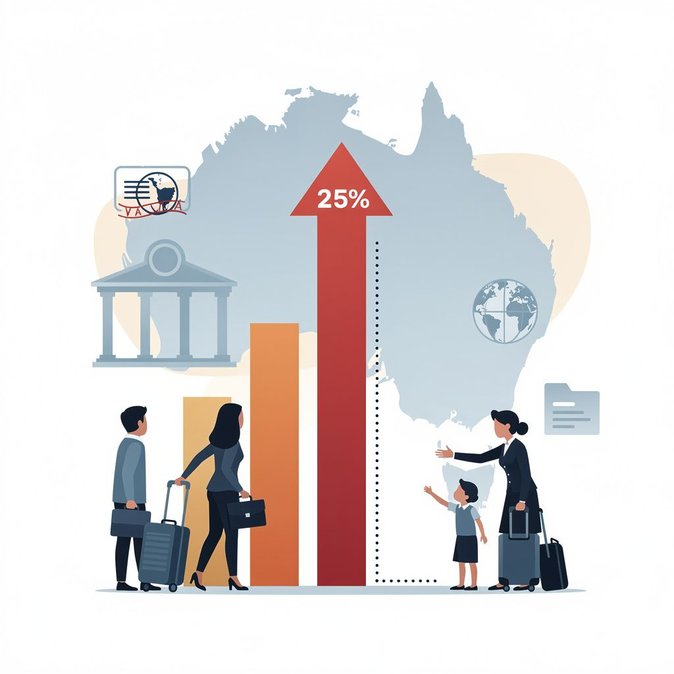
Migration advisory firm Riverwood Migration has confirmed that the fee for Australia’s on-shore and offshore Partner visas (subclasses 820/801 and 309/100) jumped 25 per cent on 1 July 2026 to AUD 11,710—the largest single-year increase since VACs were introduced three decades ago. The consultancy’s 10 July explainer outlines the full schedule of rises across more than 30 partner-and-family visa subclasses and warns applicants to budget for associated medicals, police checks and legal representation that can push total outlay above AUD 15,000.
The Home Affairs Department argues that partner-visa pricing is based on full cost recovery for processing and integrity checks, but migration agents say the eye-watering fee now exceeds the median after-tax salary for many applicants from low-income countries. For couples navigating this complex and costly process, services such as VisaHQ can streamline the paperwork, provide up-to-date fee guidance and flag any supporting documents that may avert delays. Their dedicated Australia portal lets applicants track requirements in real time and can be used alongside, or instead of, a migration agent for those trying to keep budgets under control.
With processing queues topping 120,000 applications, advocacy groups fear couples may delay reunification or turn to unlawful stay options. Community-legal centres report an uptick in requests for payment plans and pro-bono assistance. Employers with globally mobile executives are also affected: an assignee who marries a non-Australian partner midway through a posting could face an unexpected six-figure family-mobility budget hit once relocation, schooling and the higher visa fee are combined. Riverwood notes that the higher fee applies to any application lodged on or after 1 July, even if the relationship began earlier. Applicants who lodged before that date are protected from retrospective increases provided no material changes trigger a fresh application. Couples now need to weigh the higher upfront cost against the pathway to immediate permanent residence once the second-stage (subclass 801/100) visa is granted. Mobility teams should review company relocation policies to ensure sufficient allowances, negotiate salary-packaging options or explore alternative temporary visas (e.g., Temporary Skill Shortage subclass 482 secondary-applicant pathway) while permanent options are assessed. Stakeholders expect the Senate Estimates hearings in August to probe the rationale behind the price hike.
The Home Affairs Department argues that partner-visa pricing is based on full cost recovery for processing and integrity checks, but migration agents say the eye-watering fee now exceeds the median after-tax salary for many applicants from low-income countries. For couples navigating this complex and costly process, services such as VisaHQ can streamline the paperwork, provide up-to-date fee guidance and flag any supporting documents that may avert delays. Their dedicated Australia portal lets applicants track requirements in real time and can be used alongside, or instead of, a migration agent for those trying to keep budgets under control.
With processing queues topping 120,000 applications, advocacy groups fear couples may delay reunification or turn to unlawful stay options. Community-legal centres report an uptick in requests for payment plans and pro-bono assistance. Employers with globally mobile executives are also affected: an assignee who marries a non-Australian partner midway through a posting could face an unexpected six-figure family-mobility budget hit once relocation, schooling and the higher visa fee are combined. Riverwood notes that the higher fee applies to any application lodged on or after 1 July, even if the relationship began earlier. Applicants who lodged before that date are protected from retrospective increases provided no material changes trigger a fresh application. Couples now need to weigh the higher upfront cost against the pathway to immediate permanent residence once the second-stage (subclass 801/100) visa is granted. Mobility teams should review company relocation policies to ensure sufficient allowances, negotiate salary-packaging options or explore alternative temporary visas (e.g., Temporary Skill Shortage subclass 482 secondary-applicant pathway) while permanent options are assessed. Stakeholders expect the Senate Estimates hearings in August to probe the rationale behind the price hike.