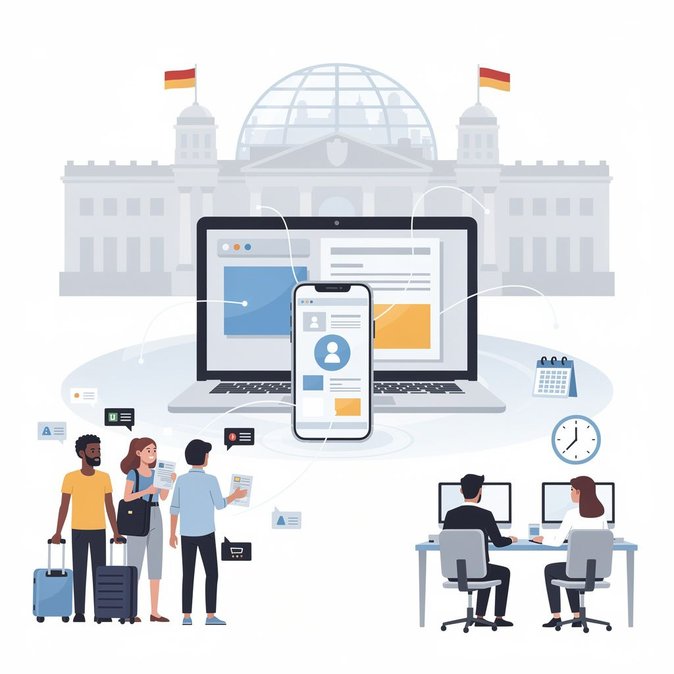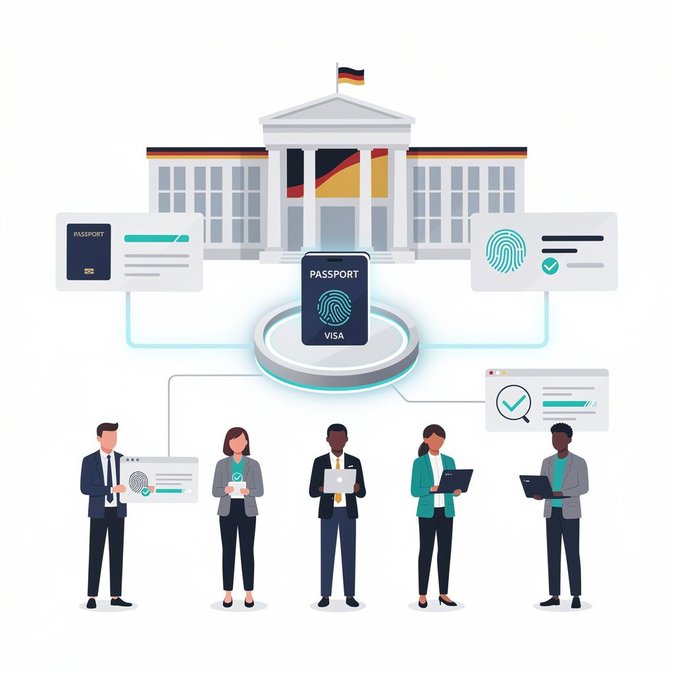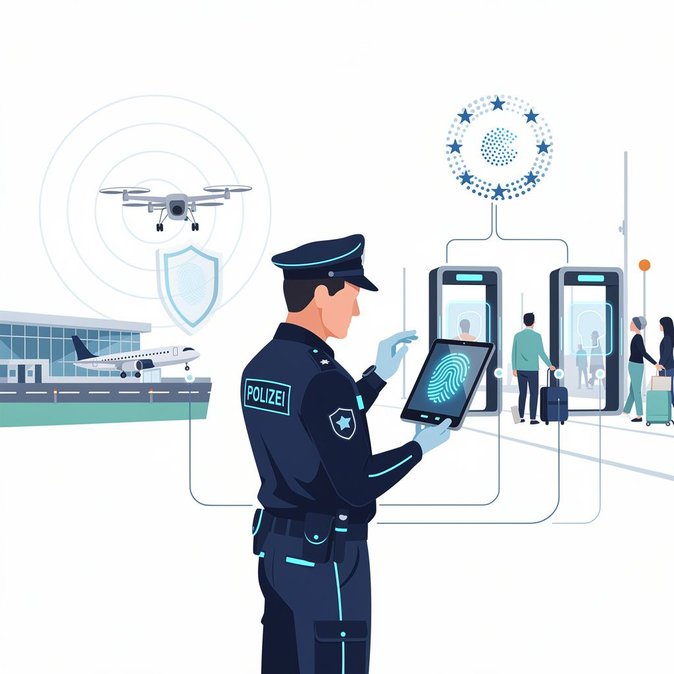
Germany’s Bundestag has approved the government’s long-awaited “Migrationsverwaltungsdigitalisierungsweiterentwicklungsgesetz” (MDWG) – literally the Act for the Further Development of Digitalisation in the Migration Administration. Adopted late on Friday, 10 July 2026, the law transforms the way Germany collects and exchanges data on visas, residence permits and asylum procedures. It creates a single technical architecture linking the Federal Office for Migration and Refugees (BAMF), foreign-missions, Länder immigration authorities and welfare agencies through the Ausländerzentralregister (AZR), Germany’s central aliens register. For the first time, biometric data captured when an e-residence permit is issued may be reused for later applications, eliminating repeated in-person visits for fingerprints and photos.
Behind the reform lies a practical business imperative: Germany issued almost 2.2 million national visas and residence permits in 2025 and expects a further rise as the new Skilled Immigration Act takes full effect. Fragmented IT systems mean companies sponsoring overseas hires often wait weeks for authorities in different Länder to share background documents. The MDWG forces all actors to store supporting documents – contracts, degree certificates, proof of accommodation – as full-text PDFs in the AZR and to make them viewable to every authority involved in the same case.
At this juncture, many employers and travellers are turning to specialist intermediaries for help. VisaHQ, through its dedicated Germany page, offers streamlined online checklists, real-time status tracking and expert review of supporting documents, ensuring that submissions already conform to the digital formats the MDWG will require. By outsourcing the administrative heavy lifting, HR teams and individual applicants can focus on planning the move rather than decoding new IT specifications.
Corporate mobility managers are likely to feel the impact first. The interior ministry estimates that digital re-use of biometrics will save at least 600,000 physical appointments a year, while fully electronic file sharing could cut average processing times for Blue Card and ICT permits by 20 days. Deloitte Germany expects large employers that move staff between locations to be able to start an application in Munich and finish it in Hamburg without re-submitting paperwork – something that was impossible under paper-based rules.
The law also introduces real-time alerts: if a court imposes criminal-law restrictions on a foreign national, the information will flow automatically from judicial databases to the local foreigners’ authority. Conversely, welfare agencies will be able to flag benefit exclusions directly in the AZR, closing long-criticised information gaps. Data-protection safeguards remain controversial; the opposition Greens abstained, warning that mass storage of documents risks “function creep” if purpose limitation is not policed.
Assuming the Bundesrat raises no objections, most provisions take effect on 1 January 2027, giving IT providers six months to adapt the interfaces. Companies that routinely relocate staff to Germany should audit their document workflows now: authorities will begin refusing paper submissions once the digital channels are live. Though bureaucratic friction will not disappear overnight, mobility specialists view the act as Germany’s biggest administrative modernisation since the 2013 e-residence card – a decisive move toward the fully digital visa file demanded by global business.
Behind the reform lies a practical business imperative: Germany issued almost 2.2 million national visas and residence permits in 2025 and expects a further rise as the new Skilled Immigration Act takes full effect. Fragmented IT systems mean companies sponsoring overseas hires often wait weeks for authorities in different Länder to share background documents. The MDWG forces all actors to store supporting documents – contracts, degree certificates, proof of accommodation – as full-text PDFs in the AZR and to make them viewable to every authority involved in the same case.
At this juncture, many employers and travellers are turning to specialist intermediaries for help. VisaHQ, through its dedicated Germany page, offers streamlined online checklists, real-time status tracking and expert review of supporting documents, ensuring that submissions already conform to the digital formats the MDWG will require. By outsourcing the administrative heavy lifting, HR teams and individual applicants can focus on planning the move rather than decoding new IT specifications.
Corporate mobility managers are likely to feel the impact first. The interior ministry estimates that digital re-use of biometrics will save at least 600,000 physical appointments a year, while fully electronic file sharing could cut average processing times for Blue Card and ICT permits by 20 days. Deloitte Germany expects large employers that move staff between locations to be able to start an application in Munich and finish it in Hamburg without re-submitting paperwork – something that was impossible under paper-based rules.
The law also introduces real-time alerts: if a court imposes criminal-law restrictions on a foreign national, the information will flow automatically from judicial databases to the local foreigners’ authority. Conversely, welfare agencies will be able to flag benefit exclusions directly in the AZR, closing long-criticised information gaps. Data-protection safeguards remain controversial; the opposition Greens abstained, warning that mass storage of documents risks “function creep” if purpose limitation is not policed.
Assuming the Bundesrat raises no objections, most provisions take effect on 1 January 2027, giving IT providers six months to adapt the interfaces. Companies that routinely relocate staff to Germany should audit their document workflows now: authorities will begin refusing paper submissions once the digital channels are live. Though bureaucratic friction will not disappear overnight, mobility specialists view the act as Germany’s biggest administrative modernisation since the 2013 e-residence card – a decisive move toward the fully digital visa file demanded by global business.