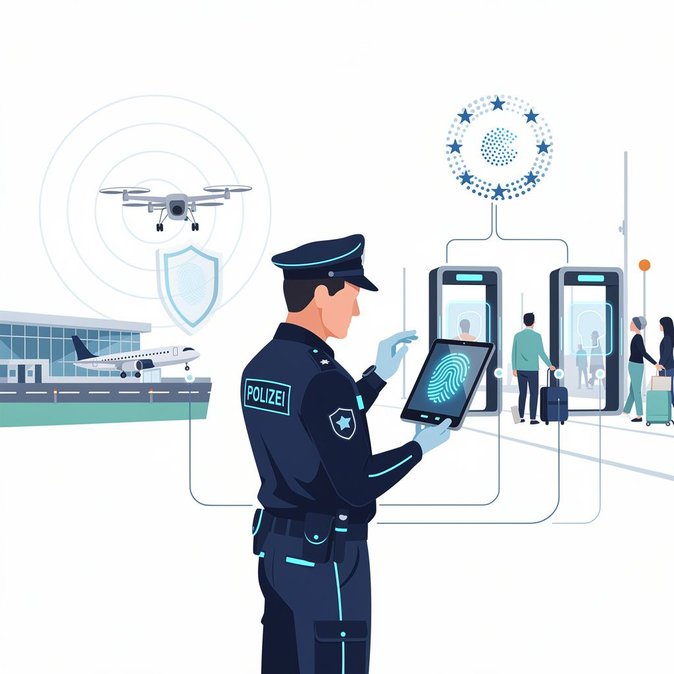
In a second major late-night vote on 10 July 2026, the Bundestag adopted the long-debated overhaul of the Federal Police Act—Germany’s first full rewrite of the law since 1994. While officially aimed at ‘modernising’ policing tools, the legislation carries direct implications for international travellers, corporate assignees and mobility managers responsible for duty-of-care compliance. For the first time the Federal Police (BPOL) will be authorised to deploy anti-drone systems around airports, major rail junctions and seaports. Fraport and other airport operators pushed hard for the change after several drone-related closures cost airlines millions in 2025. Business travellers can expect fewer last-minute diversions and delays once the new counter-UAV units are installed at Frankfurt, Munich and Berlin later this year.
Amid these regulatory shifts, VisaHQ’s German portal can be a quick starting point for mobility managers and individual travellers to confirm current entry rules, Schengen documentation requirements and any biometric-passport specifications before crossing the updated 30-kilometre border zone. The platform’s real-time alerts and concierge support help companies maintain duty-of-care compliance while navigating the Federal Police’s expanded identity-check and data-access powers.
The act also clarifies identity-check powers in the 30-kilometre Schengen border zone, an area that has seen temporary controls with Poland, Czechia and Switzerland since 2024. Officers may now verify biometric passports using mobile EES readers and—if risk scoring justifies—query EU entry-exit data in real time. Companies moving goods or staff across those land borders will need to brief drivers on tighter spot checks and ensure travellers carry proper documentation, especially during the transition to the new European Entry/Exit System. Data-protection safeguards were a key sticking point. Parliament inserted an explicit right for individuals to request a record of personal data stored by BPOL and tightened rules on when body-cam footage may be retained. Civil-rights groups regret that randomised search protocols were not included but concede the law is an improvement on the 1990s statute. Implementation will be rapid: the Interior Ministry has signalled that subordinate regulations will enter force by November 2026, ahead of the Christmas travel peak. Multinational employers should update travel-risk matrices and inform staff that on-the-spot electronic checks at border rail stations (e.g., Freilassing, Görlitz, Basel Bad Bf) will become more frequent. Despite civil-liberties controversy, the act is expected to streamline security procedures and reduce event-related shutdowns—ultimately supporting smoother passenger flows through Germany’s critical gateways.
Amid these regulatory shifts, VisaHQ’s German portal can be a quick starting point for mobility managers and individual travellers to confirm current entry rules, Schengen documentation requirements and any biometric-passport specifications before crossing the updated 30-kilometre border zone. The platform’s real-time alerts and concierge support help companies maintain duty-of-care compliance while navigating the Federal Police’s expanded identity-check and data-access powers.
The act also clarifies identity-check powers in the 30-kilometre Schengen border zone, an area that has seen temporary controls with Poland, Czechia and Switzerland since 2024. Officers may now verify biometric passports using mobile EES readers and—if risk scoring justifies—query EU entry-exit data in real time. Companies moving goods or staff across those land borders will need to brief drivers on tighter spot checks and ensure travellers carry proper documentation, especially during the transition to the new European Entry/Exit System. Data-protection safeguards were a key sticking point. Parliament inserted an explicit right for individuals to request a record of personal data stored by BPOL and tightened rules on when body-cam footage may be retained. Civil-rights groups regret that randomised search protocols were not included but concede the law is an improvement on the 1990s statute. Implementation will be rapid: the Interior Ministry has signalled that subordinate regulations will enter force by November 2026, ahead of the Christmas travel peak. Multinational employers should update travel-risk matrices and inform staff that on-the-spot electronic checks at border rail stations (e.g., Freilassing, Görlitz, Basel Bad Bf) will become more frequent. Despite civil-liberties controversy, the act is expected to streamline security procedures and reduce event-related shutdowns—ultimately supporting smoother passenger flows through Germany’s critical gateways.