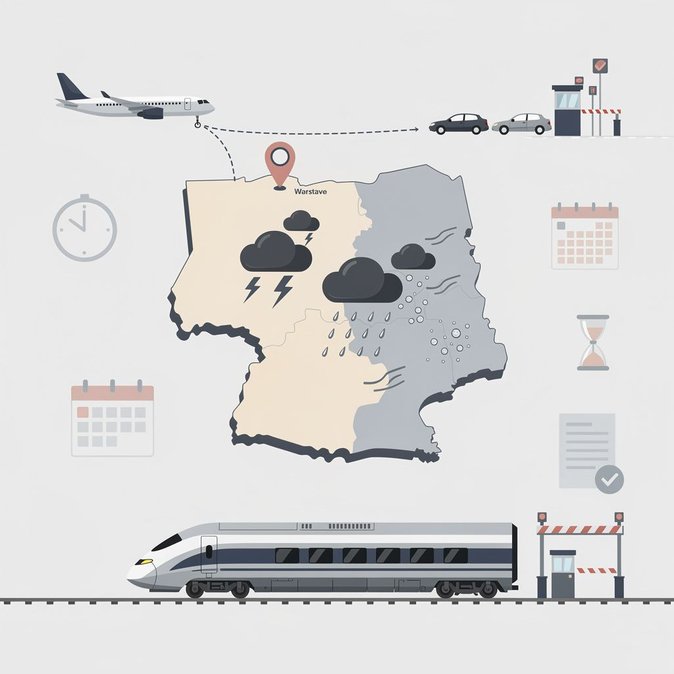
Business and leisure travelers planning to cross Poland this weekend should brace for weather-related delays after the national meteorological institute (IMGW) issued first-level thunderstorm warnings for four eastern and north-eastern voivodeships on Saturday, 11 July 2026. The alerts cover the entire Podlaskie region as well as parts of Lubelskie, Warmińsko-Mazurskie and Mazowieckie and are in force from 12:00 to 19:00 local time. Forecasters expect downpours of 20–25 mm, wind gusts up to 60 km/h and pockets of small hail. Although a level-one alert is the mildest on Poland’s three-tier warning scale, it obliges infrastructure managers, carriers and event organisers to trigger contingency plans. Warsaw-based airline operations managers told Global Mobility News that crews have been instructed to carry extra holding fuel for flights into Chopin and Modlin airports and to anticipate short-notice runway direction changes. Rail operator PKP Intercity has activated its „Storm Desk”, ready to impose speed restrictions on exposed segments of the east-west trunk line should lightning activity intensify. Travel insurers note that weather remains one of the few legally accepted grounds for denied-boarding compensation under EU261 rules, provided carriers can demonstrate they took all reasonable mitigation steps. Companies with short-term assignees arriving from the United States and Asia on Saturday afternoon should therefore monitor flight status proactively and consider re-routing via airports in western Poland or Berlin if schedules are critical. Ground handlers at Warsaw Chopin report that the busiest arrival bank—between 15:00 and 18:00—coincides with the peak of the expected storm cell, increasing the likelihood of knock-on delays through Sunday morning. IMGW expects conditions to stabilise overnight, but residual showers may persist in the border zones with Belarus and Lithuania, where Poland still maintains temporary passport checks. Travellers using road crossings at Kuźnica or Budzisko early Sunday could therefore face slower processing as officers balance weather safety procedures with standard Schengen-code inspections. Companies should advise drivers to allow at least one extra hour of buffer time. In practical terms, mobility managers should: (1) alert travellers via duty-of-care apps, (2) reconfirm hotel late-arrival policies and chauffeur pick-ups, (3) remind employees to keep boarding passes and delay certificates for insurance claims, and (4) verify that remote-work hardware carried in hand luggage is adequately protected against moisture. As Europe heads into the late-summer thunderstorm season, the episode underscores the importance of pairing real-time meteorological feeds with travel-risk analytics when planning cross-border assignments.
Source: NewMedia24