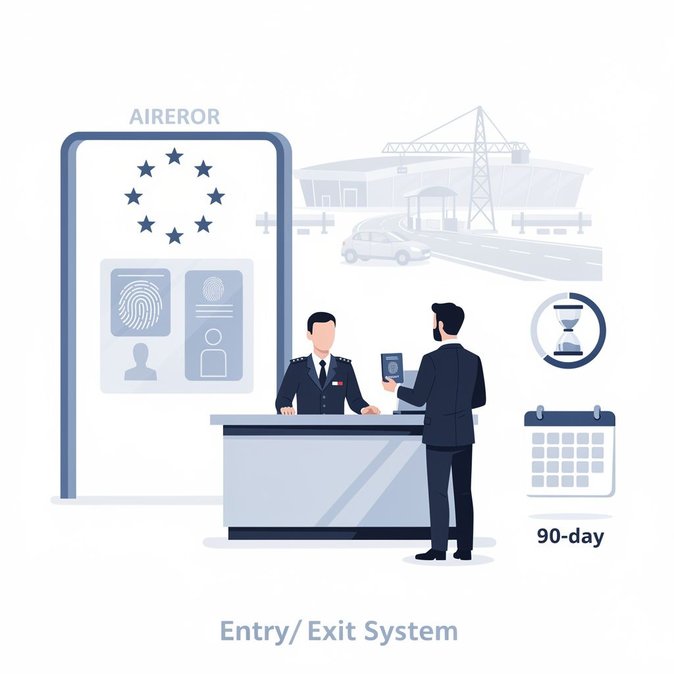
Poland awoke this morning, 10 July 2026, to the first full day of the European Union’s long-awaited Entry/Exit System (EES). Border officers at Warsaw-Chopin, Kraków-Balice and the key road crossings with Ukraine and Slovakia switched from manually stamping passports to capturing fingerprints and facial images of every non-EU traveller who arrives or departs.
For visitors unsure how the switch from stamps to biometrics affects their allowable time in the country, VisaHQ offers an easy reference point. Its Poland portal automatically calculates your remaining Schengen days, highlights documentation you may still need, and can even pre-fill forthcoming ETIAS requests—making compliance far simpler while the new system beds in.
The new biometric gate procedure, mandated by EU Regulation 2017/2226, automatically starts a 90-day countdown for short-stay visitors and records each exit so that over-stayers can be flagged across the Schengen database. By 09:00 local time, Warsaw-Chopin reported average processing times of 2 m 20 s per third-country passenger—about one minute longer than a week ago—according to internal data shared with handling agents. At the Budzisko and Ogrodniki checkpoints on the temporarily controlled Poland-Lithuania border, motorists told local radio station RDC they waited “almost an hour” while officers familiarised themselves with portable fingerprint scanners. Airlines had been warning of possible disruption all week. Industry bodies ACI Europe and IATA wrote an open letter on 1 July urging Brussels to let Member States suspend EES during peak periods; Ryanair went further, calling on the Polish government to delay implementation until September after trial runs over the May bank-holiday caused hour-long passport queues. Polish authorities rejected the plea, insisting the summer surge was the best real-world test of the system. For corporate mobility managers the practical advice is simple: build in at least 30 minutes of extra time for airport departures over the next fortnight, alert frequent travellers that passport stamps will disappear, and remind contractors on short-term projects that the clock toward their 90/180-day Schengen limit now starts automatically. Employers should also prepare for tighter enforcement of over-stay fines—up to PLN 13 000 (€3 000)—once the database matures. Looking ahead, the EES database will feed directly into the Electronic Travel Information and Authorisation System (ETIAS), which the European Commission now plans to activate in late 2027. Once both platforms are integrated, Polish border guards expect most compliant non-EU visitors to clear e-gates in under 45 seconds, but only after the inevitable bedding-in period of the next few weeks.
For visitors unsure how the switch from stamps to biometrics affects their allowable time in the country, VisaHQ offers an easy reference point. Its Poland portal automatically calculates your remaining Schengen days, highlights documentation you may still need, and can even pre-fill forthcoming ETIAS requests—making compliance far simpler while the new system beds in.
The new biometric gate procedure, mandated by EU Regulation 2017/2226, automatically starts a 90-day countdown for short-stay visitors and records each exit so that over-stayers can be flagged across the Schengen database. By 09:00 local time, Warsaw-Chopin reported average processing times of 2 m 20 s per third-country passenger—about one minute longer than a week ago—according to internal data shared with handling agents. At the Budzisko and Ogrodniki checkpoints on the temporarily controlled Poland-Lithuania border, motorists told local radio station RDC they waited “almost an hour” while officers familiarised themselves with portable fingerprint scanners. Airlines had been warning of possible disruption all week. Industry bodies ACI Europe and IATA wrote an open letter on 1 July urging Brussels to let Member States suspend EES during peak periods; Ryanair went further, calling on the Polish government to delay implementation until September after trial runs over the May bank-holiday caused hour-long passport queues. Polish authorities rejected the plea, insisting the summer surge was the best real-world test of the system. For corporate mobility managers the practical advice is simple: build in at least 30 minutes of extra time for airport departures over the next fortnight, alert frequent travellers that passport stamps will disappear, and remind contractors on short-term projects that the clock toward their 90/180-day Schengen limit now starts automatically. Employers should also prepare for tighter enforcement of over-stay fines—up to PLN 13 000 (€3 000)—once the database matures. Looking ahead, the EES database will feed directly into the Electronic Travel Information and Authorisation System (ETIAS), which the European Commission now plans to activate in late 2027. Once both platforms are integrated, Polish border guards expect most compliant non-EU visitors to clear e-gates in under 45 seconds, but only after the inevitable bedding-in period of the next few weeks.