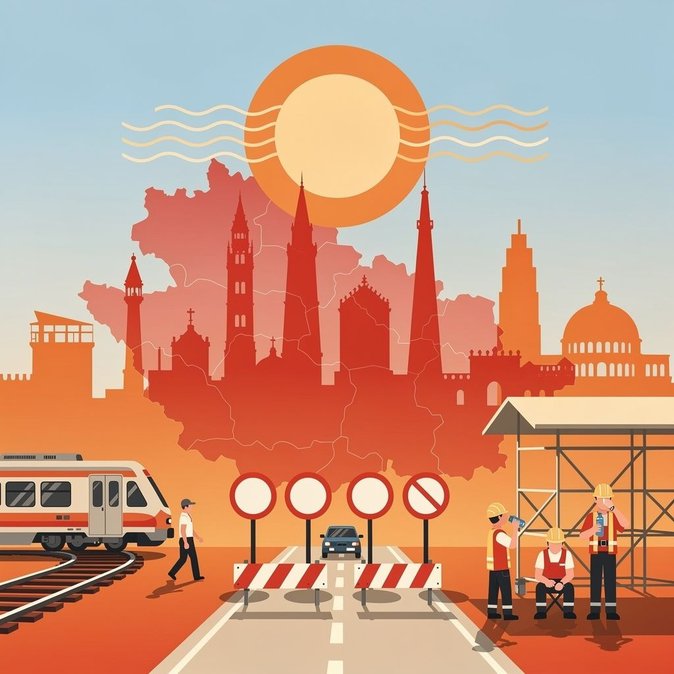
Italy’s Ministry of Health issued an updated heat-health bulletin on 13 July placing seven cities – including Florence, Perugia and Rome – under level-3 “red alert” through Wednesday, with daytime highs expected to touch 40 °C. Nine other urban centres move to orange. Although primarily a public-health warning, the alert has direct mobility consequences: municipal authorities can cap road traffic during peak hours, and rail infrastructure operator RFI has already instructed crews to impose speed restrictions if track temperatures exceed safety thresholds. The labour ministry’s 2025 guidelines require employers to reschedule outdoor work when the heat index breaches 35, a threshold now likely to be met across much of central Italy. Logistics firms report that some courier depots have shifted loading slots to before 10 a.m., while construction unions have called a two-hour stoppage in Tuscany on 15 July to demand stronger protections. Business-travel itineraries that involve long road segments or field inspections should therefore be reviewed. Travellers transiting Rome-Termini and Florence-Santa Maria Novella railway stations should expect platform changes as Trenitalia allocates rolling stock with functional air-conditioning to longer routes. Airlines operating at Fiumicino warn that ground-handling delays may rise because ramp agents must take compulsory breaks every 15 minutes once tarmac temperatures top 45 °C. Companies with expatriate populations in the affected cities should circulate heat-stress advice – hydration plans, remote-work options and emergency contact numbers – and verify that accommodation has adequate cooling. Insurance providers remind policyholders that evacuations for heatstroke count as medical claims, not security incidents, so pre-authorisation is essential. The ministry will issue the next bulletin at 08:00 on 14 July; if the red-alert list expands, local authorities could restrict heavy-vehicle access to historic centres, impacting last-mile deliveries. Mobility managers are advised to remain on watch over the next 72 hours.
Source: Open.online