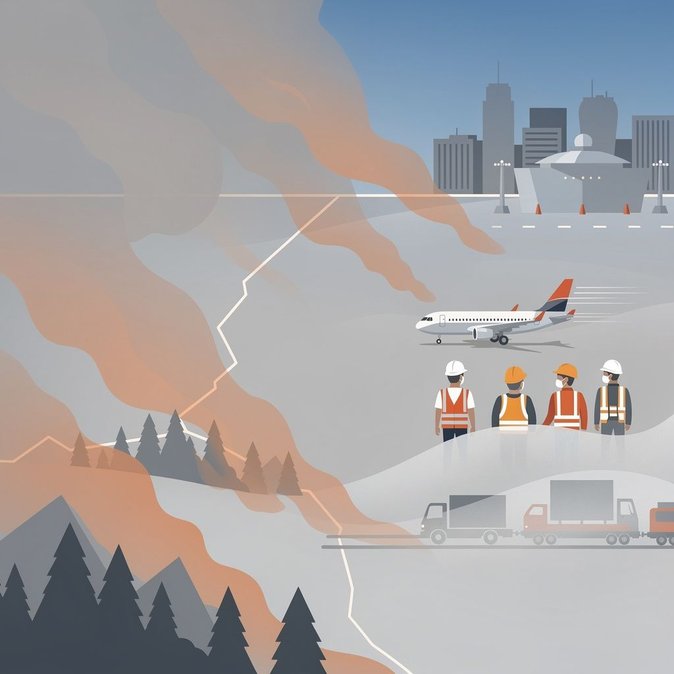
Environment Canada issued special air-quality statements for southeastern British Columbia and parts of Alberta on July 20 after dense smoke from large wildfires in Washington and Oregon drifted north of the 49th parallel. The warnings come days after U.S. president Donald Trump threatened new tariffs on Canada over trans-boundary “dirty air,” escalating a political spat that has added an unexpected layer of risk to cross-border movement. Provincial health authorities advised residents and travellers in the Kootenay Lake and Cranbrook regions to limit outdoor activity and, where possible, use high-efficiency particulate air (HEPA) filtration indoors. Airlines serving nearby airports in Castlegar (YCG) and Cranbrook (YXC) reported minor visibility-related delays, and helicopter operators supporting mining and forestry sites imposed stricter flight-duty windows. For business travellers, the smoke has practical implications. Companies routing staff through the Vancouver–Calgary corridor should monitor flight schedules closely and brief employees on symptoms of smoke inhalation. Organisations with outdoor worksites must review provincial occupational-health regulations, which now mandate work-rest ratios or task suspension when the Air Quality Health Index (AQHI) exceeds 7. Travellers with cardiorespiratory conditions are advised to carry N95 masks and to download the WeatherCAN app for real-time AQHI readings. Transport Canada has not issued nationwide guidance, but the episode highlights growing climate-related volatility affecting mobility planning. Last summer’s record-setting fire season prompted several multinational firms to embed smoke contingencies—such as alternative routing via Edmonton or Prince George—into travel management systems. This year, carriers are increasingly using satellite-based trajectory forecasts to adjust flight levels and minimise particulate exposure for crew and passengers. While meteorologists expect a gradual improvement as winds shift later this week, analysts warn that prolonged cross-border smoke events may influence U.S.–Canada negotiations on aviation emissions and could complicate insurance coverage for delayed cargo. Mobility teams should track evolving political rhetoric, as retaliatory trade measures could quickly spill over into visa processing or customs inspections.
Source: The Guardian