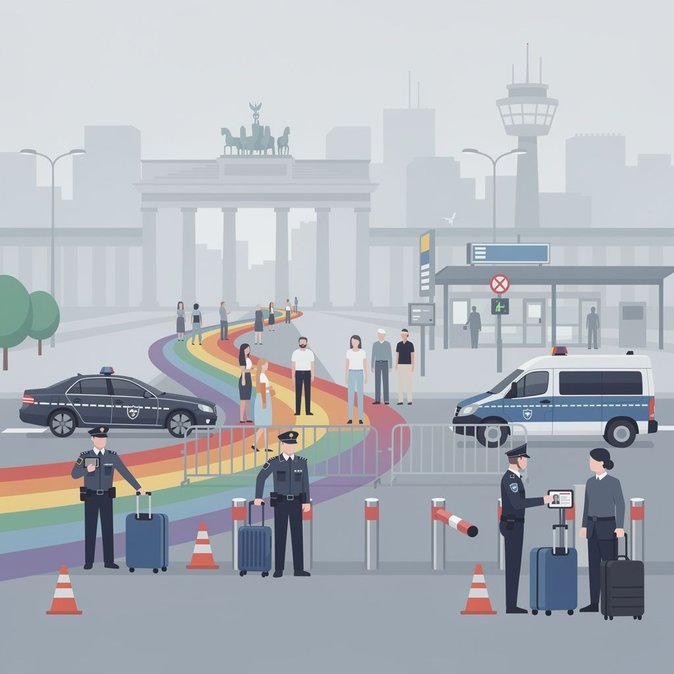
Germany’s internal security debate spilled over into mobility policy on 27 July after Saturday’s fatal vehicle attack on Berlin’s Christopher Street Day parade. In a televised statement, Interior Minister Alexander Dobrindt said the government was ‘reviewing the entire funnel—from visa issuance to entry controls and domestic surveillance—to understand how the perpetrator slipped through’. According to Deutsche Welle, the suspect is a 24-year-old German-Iraqi dual national who had been on a watch-list but was able to rent a van and drive unchallenged across state borders before ploughing into spectators near the Tiergarten. Opposition MPs seized on the incident to demand mandatory biometric exit controls on inter-state highways and random identity checks on domestic flights—measures that would mark a significant shift from Germany’s traditionally liberal approach to movement inside the country. For global mobility managers the immediate impact is higher visibility policing at airports, mainline stations and large events. The Bundespolizei confirmed to GM News that extra patrols were deployed to Frankfurt Airport’s Terminal 1 and Berlin BER overnight, with officers instructed to conduct spot-checks on passengers carrying large luggage or rental-van keys. Travellers should expect occasional delays at curbside drop-off zones, though the interior ministry said no systematic controls would be introduced without parliamentary debate. Longer-term, the attack could accelerate Germany’s plan—already floated in the coalition agreement—to link the national Schengen information system with domestic vehicle-rental databases, giving authorities real-time alerts when flagged individuals pick up a truck or van. Corporate security directors are being advised to add Berlin to their ‘heightened alert’ destination lists and remind business travellers to carry both a passport/ID card and company ID when moving between federal states. Context: Germany’s threat level had been at “substantial” since the 2024 Vienna train-station bombing, but Saturday’s attack during a high-profile LGBT+ event has renewed pressure on the government to show it can prevent lone-actor terrorism—especially ahead of state elections in Brandenburg and Saxony this autumn. Any tightening of domestic mobility rules will be closely watched by multinationals that rely on friction-free travel within Germany for client visits and project work.
Source: Deutsche Welle