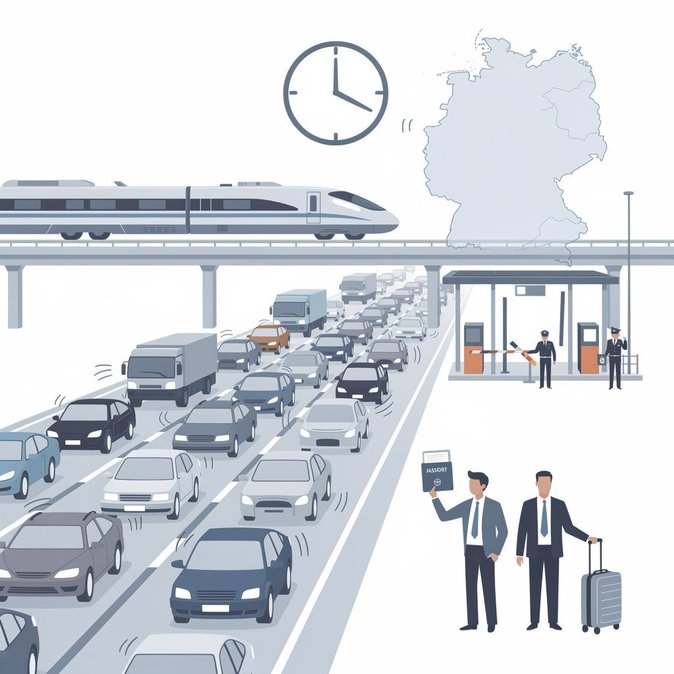
Germany’s motorists’ association ADAC warns that the weekend of 24–26 July will witness the "second holiday wave" and possibly the worst congestion of the season. In its Stauprognose published at 10:55 CET on 24 July 2026, the club highlights more than 1,000 construction sites, multiple full motorway closures and—crucially for international travellers—lengthy waits at all land borders because of ongoing stationary checks introduced in May 2025. The bottlenecks are expected to peak Friday afternoon and Sunday evening, affecting arterial routes such as the A3 (Suben) and A8 (Walserberg) for traffic to Austria as well as the A4 (Ludwigsdorf) and A12 (Frankfurt Oder) towards Poland. ADAC notes that trans-European truckers now average 35–45 minutes at certain crossings, with passenger cars facing up to one hour during rush periods. Business-traveller implications are two-fold. First, door-to-door journey times for domestic road trips may double, impacting just-in-time deliveries and field-service appointments. Second, meeting schedules that rely on cross-border drives to Salzburg, Basel or Wrocław should be padded by at least 60 minutes. HR mobility policies may need to reimburse overnight stays or allow rail alternatives. The forecast also reminds companies that Germany’s Saturday lorry ban (07:00–20:00) remains in force through 31 August, a factor supply-chain managers must integrate into dispatch planning. With many federal states now on school holidays, ADAC advises flexible working or tele-meetings where possible. Finally, the association reiterates legal obligations to carry passports near borders—even on purely domestic itineraries that pass close to the frontier—because police frequently conduct spot checks on feeder roads. Employers should brief international assignees unfamiliar with Schengen’s current suspension.
Source: ADAC