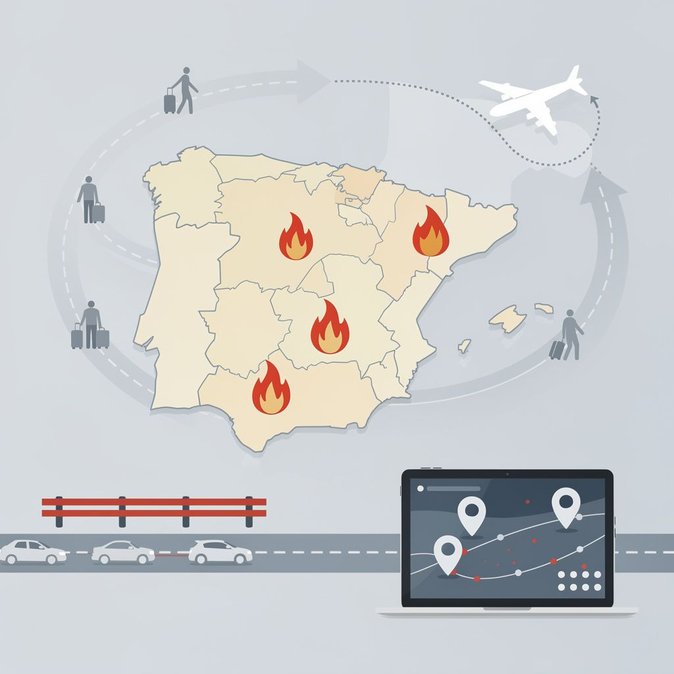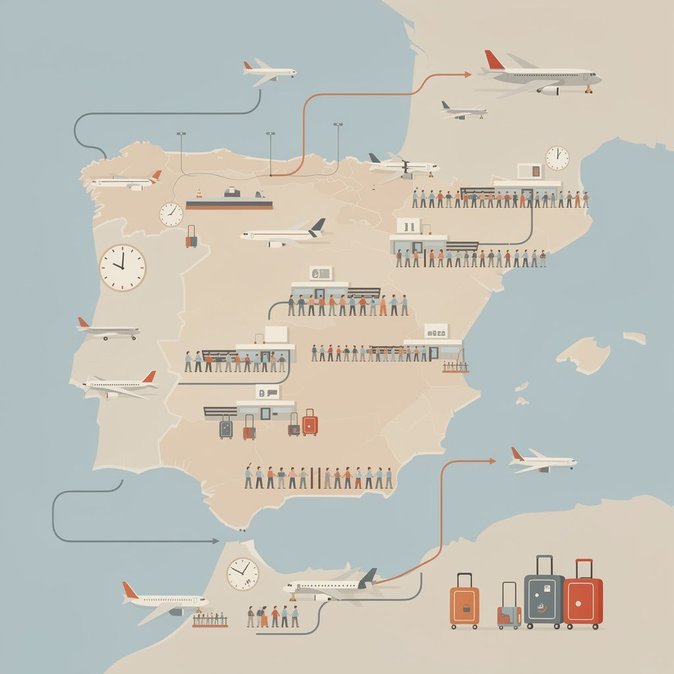
Spanish travel managers are bracing for a choppy end to the summer after the Federation of Aviation Workers (FTA) announced on 27 July a coordinated series of walk-outs that will affect ground handling, ramp services and some air-traffic-control functions at 17 airports between 28 July and 8 September. The union said talks with airport operator AENA and outsourced service providers had stalled over pay parity and split-shift scheduling. The strike calendar begins on Tuesday 28 July at Palma de Mallorca (PMI), where baggage handlers will stop work for four-hour blocks coinciding with the morning and evening long-haul banks. Additional 24-hour stoppages are programmed for 1, 4 and 8 August, then every Friday and Monday through to 5 September. Workers at Madrid-Barajas, Barcelona-El Prat and Málaga have filed “sympathy notices” covering 15-18 August and the first weekend of September. Under Spanish minimum-service legislation, 50–60 % of international flights on high-demand routes must still operate, together with 70–80 % of domestic services. Nonetheless, airlines are drawing up contingency plans involving lighter aircraft rotations, hand-luggage-only advisories and same-day ferrying of critical spare parts to the islands. Corporate travel departments with high volumes into Spain have begun re-routing executives via Lisbon, Toulouse or even Tangier to avoid the heaviest disruption. Relocation companies are also rescheduling household-goods shipments that require excess-baggage carriage. Christopher Lane, mobility lead at a US tech firm in Málaga’s Andalusia Tech Park, told Global Mobility News he has placed a hold on all short-notice TDY assignments until at least 9 September. Should talks fail, the FTA warns it will ballot for an indefinite nationwide strike from 15 September, coinciding with the return-to-school rush and key trade fairs such as Madrid’s Fruit Attraction and Barcelona’s Seafood Expo. Mobility managers are advised to secure flexible airfares, monitor union communiqués and book refundable accommodation.
Source: Cain Travel Risk Alert