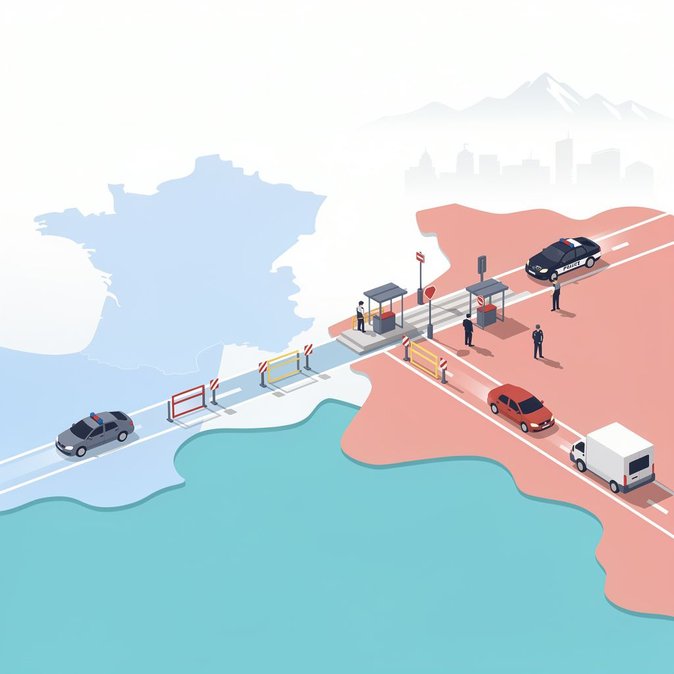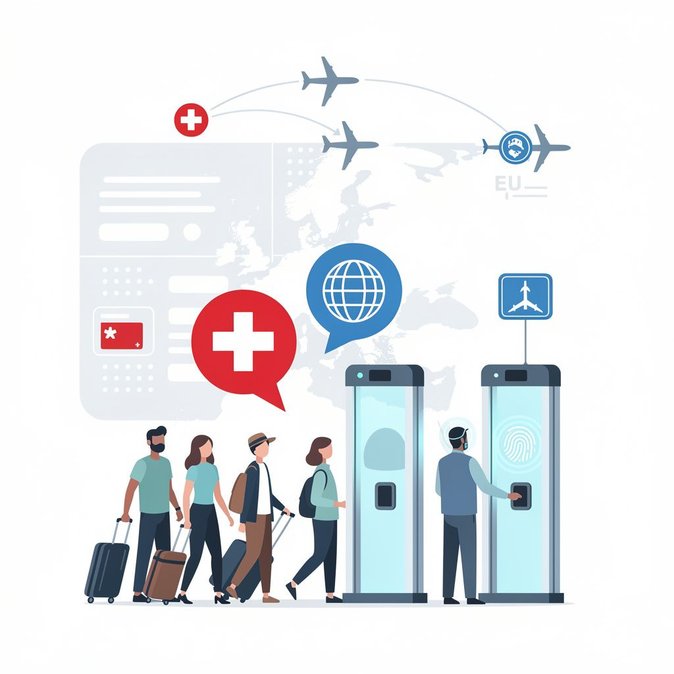
The European Commission has formally announced that the new Entry/Exit System (EES) is now operational at every external Schengen border-crossing point. Introduced on 10 April 2026 and confirmed in a detailed update on 27 July, the biometric database already holds more than 145 million entry and exit records. The aim is to replace manual passport stamping with facial-image and fingerprint capture for short-stay, non-EU travellers, closing a long-criticised security gap and enabling Schengen states to enforce the 90/180-day stay rule automatically. For Swiss corporates the key takeaway is that the exemption list explicitly includes “nationals of EU countries and of Iceland, Liechtenstein, Norway or Switzerland.” Swiss citizens – as well as non-EU family members who hold Swiss residence cards – will therefore continue to pass external Schengen controls without biometric enrolment. Long-stay visa or residence-permit holders are also exempt. Business travellers entering the EU on Swiss service passports or national D-visas should nevertheless be prepared for longer queues during the transition as carriers and border staff work with two sets of passenger flows. HR mobility teams should update pre-departure briefings for third-country assignees based in Switzerland. Non-EU employees (for example U.S. or Indian nationals) with Swiss B-permits remain exempt when holding the permit card, but contractors arriving on a 90-day Schengen visa waiver will be fingerprinted and photographed. The change means overstays will now feed directly into an EU-wide alert system, raising the compliance stakes for short business trips to nearby client sites in Germany, France or Italy. Airports in Zurich, Geneva and Basel have signalled that, although they host no external Schengen borders themselves, they expect knock-on effects: connecting passengers entering Schengen at hubs such as Frankfurt or Paris CDG may face additional processing time. Travel managers are therefore advised to pad connections by at least 45 minutes until traffic stabilises. Digital registration kiosks will progressively shorten wait times, but analyst firm Polarys expects full operational maturity only by early 2027. Looking ahead, the EES will interface with the delayed ETIAS travel-authorisation programme, now slated for late 2026. Companies headquartered in Switzerland should ensure that visitor-management tools can capture both ETIAS approvals and EES entry data to maintain a clear audit trail for duty-of-care purposes.