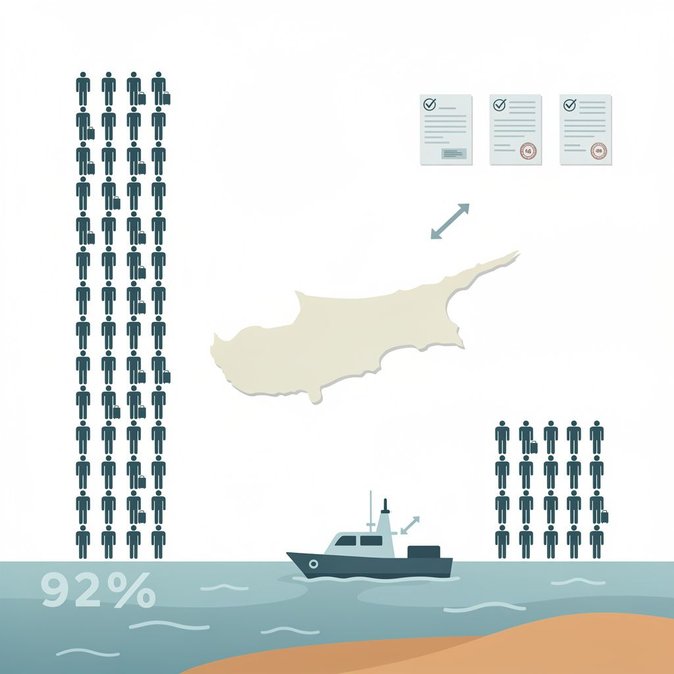
Cyprus’ Deputy Minister for Migration and International Protection, Nicholas Ioannides, told reporters on 31 July that the Republic has registered a dramatic fall in unauthorised border crossings and asylum claims over the past two years. According to Ioannides, only 1 690 irregular arrivals were recorded in the first half of 2026, compared with more than 21 000 during the same period in 2022. New asylum applications fell even more sharply—from roughly 27 000 to just under 2 000—bringing the island’s caseload back to pre-crisis levels. The minister attributed the turnaround to a “decisive and strict” strategy centred on three pillars: reinforced patrols along the Green Line and Cyprus’ maritime borders, accelerated adjudication of asylum claims, and an expanded programme of voluntary and forced returns. Some 4 145 migrants were repatriated between January and June, while total departures—voluntary and involuntary—surpassed 5 000 by 30 July. Ioannides said pending asylum backlogs have been cut almost in half, to 13 500 claims, since the Deputy Ministry was created in June 2024. Behind the numbers is closer operational cooperation with Frontex, Europol and neighbouring Lebanon, as well as Ankara’s tacit agreement to curb crossings from the Turkish-controlled north into the Republic. Cyprus has also prioritised information campaigns in origin countries and stricter penalties for smugglers. Combined with Syria’s political stabilisation and Turkey’s tighter visa rules for Syrians, the measures have reduced applications from Syrian nationals by more than 96 %. For multinational employers, the fall in irregular arrivals may eventually ease pressure on Cyprus’ reception system and free up administrative capacity for legal labour migration. Immigration lawyers, however, warn that the tougher stance also means stricter document checks at ports and airports and a greater likelihood of detention for status-overstayers. Companies placing staff in Cyprus are advised to ensure that residence permits and labour contracts are fully compliant and to build in longer lead times for Green Line crossings. Ioannides urged Syrian nationals whose protection needs have ceased to take advantage of Cyprus’ revised Assisted Voluntary Return Scheme before it expires on 30 October 2026, warning that forced removals will resume thereafter. The ministry plans to publish updated guidance for employers and universities on how the new enforcement posture affects work-permit conversions and student-to-work transitions in the coming weeks.
Source: Cyprus Mail