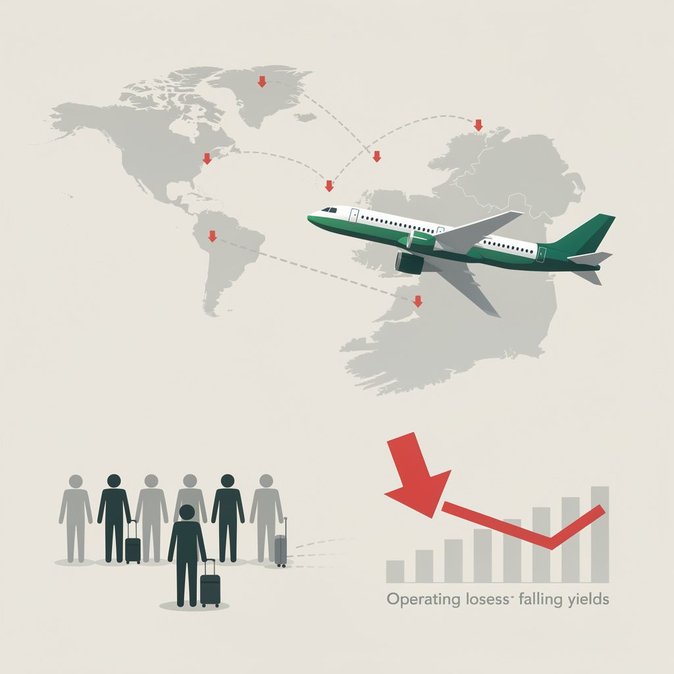
Aer Lingus, Ireland’s flag carrier and the country’s largest long-haul airline, confirmed on 1 August that it slipped to a €34 million operating loss for the first six months of 2026, compared with an €80 million profit a year earlier. Management blamed an 8 % surge in operating costs—driven by higher fuel, airport and labour expenses—combined with a 3 % decline in passenger yields as competition on key North Atlantic routes intensified. Although passenger numbers inched up by 1.2 %, fares fell markedly on Dublin–Boston and Dublin–Chicago services, where new capacity from U.S. carriers entered the market. Chief Executive Lynne Embleton told staff that a "comprehensive cost-review programme" is under way. Up to 500 positions—mostly in head-office and ground operations—are being evaluated for redundancy, and the airline is reviewing the viability of several winter 2026/27 routes, including Dublin–Cleveland and Shannon–Paris. The carrier is also in talks with parent group IAG about deferring delivery of three A321LR aircraft scheduled for next summer. Any fleet reshuffle could further concentrate long-haul flying at Dublin, reducing regional connectivity for business travellers in Cork and Shannon. For multinational companies that rely on Aer Lingus for trans-Atlantic shuttles and cargo uplift, the prospect of schedule reductions raises immediate mobility planning issues. Travel managers may need to shift traffic onto U.S. alliance partners or reroute through London to preserve same-day connections to Ireland’s tech and pharmaceutical hubs. Capacity constraints could also push up peak-season fares in 2027 just as companies finalise budgets. Industry analysts note that Aer Lingus’ ability to pass higher costs on to passengers is constrained by Ryanair’s aggressive expansion at Dublin and increased competition from United and Delta, both of which have added larger-gauge wide-bodies on Irish routes. If fuel prices remain elevated, the carrier may lobby the Government for more flexible slot and charge regimes at Dublin Airport—now no longer subject to a legal passenger cap—to protect hub economics. In the short term, travellers should monitor flight status closely and consider booking fully refundable tickets until Aer Lingus publishes its revised winter schedule later this month. Employers with assignees relocating between Ireland and North America should build contingency travel days into assignment letters and communicate alternative routings via London, Paris or Frankfurt in case of sudden cancellations.