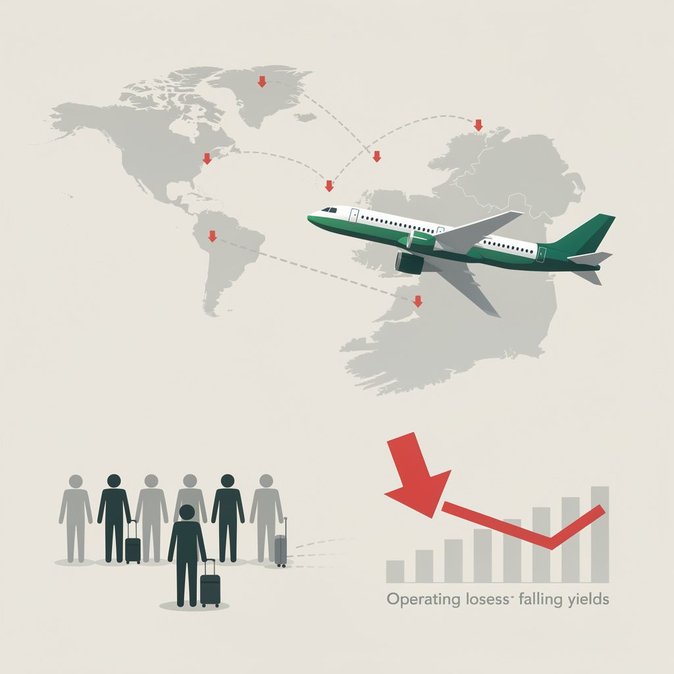
Aer Lingus, the Republic of Ireland’s flag carrier, reported an operating loss of €34 million for the six months to 30 June 2026, reversing an €80 million profit in the same period last year. Parent company International Airlines Group (IAG) blamed higher fuel costs, a weaker euro and intense price competition on North-Atlantic routes for the downturn. While IAG remained profitable overall—posting net earnings of €1.03 billion, down 20% year-on-year—the Irish unit was the only airline in the group to fall into the red. Industry analysts say Aer Lingus has been squeezed on both sides of the Atlantic. On eastbound flights, the airline must now vie with a record number of transatlantic services at Dublin Airport following the removal of the 32-million-passenger cap earlier this summer. On westbound services, it faces aggressive capacity growth from U.S. network carriers and newcomers such as Norse Atlantic, which continue to discount fares to protect market share. The carrier’s unit revenues on North-Atlantic routes fell 6.4%, more than wiping out a modest 1.2% increase in passenger numbers. Rising costs added further pressure. IAG’s fuel bill jumped 12.3% in the half-year, and Aer Lingus was disproportionately affected because long-haul flying accounts for almost 70% of its available seat-kilometres. Management has already parked two older A330-300s and delayed discretionary cabin-upgrade projects. Sources inside the airline say head-office and airport roles could be cut by up to 500 posts as part of a €70 million cost-saving drive due to be announced in September. For global mobility managers and business travellers, the immediate concern is schedule stability. Aer Lingus has hinted it may consolidate frequencies on marginal U.S. routes such as Philadelphia and Minneapolis this winter, and code-share partners—including British Airways and JetBlue—have issued “schedule change” alerts to corporate clients. Travel buyers with large volumes over Dublin are being advised to build additional connection buffers or route through Heathrow or continental hubs if time-critical. Longer term, the loss underscores Ireland’s dependence on a single network carrier for direct long-haul connectivity. If Aer Lingus cannot restore profitability quickly, it may become harder for multinationals to justify Irish assignments that rely on nonstop lift to North America. The government’s forthcoming Aviation White Paper, expected in October, will therefore be watched closely for any measures—such as fuel tax relief or slot-allocation support—designed to shore up the carrier’s competitiveness.
Source: Cinco Días (El País)