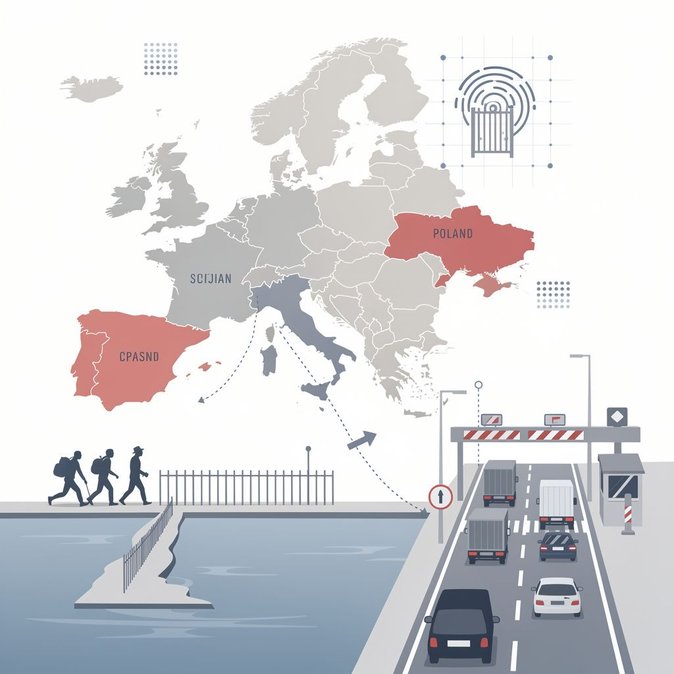
Poland has signed a joint letter with 21 other European Union member-states urging the EU’s Irish Council Presidency to convene an emergency video-conference of interior ministers after an unprecedented mass crossing of an estimated 60 000 migrants into Spain’s North-African enclave of Ceuta on 31 July. The letter, whose signatories include Italy, Denmark, Germany and the Baltic states, argues that the breach "undermines confidence in our common migration policy" and calls for a coordinated response that keeps the integrity of Schengen’s external borders intact. Although the incident took place more than 3 000 km from Warsaw, Poland’s government views it through the lens of its own experience with orchestrated migrant pressure on the Polish–Belarusian frontier since 2021. Warsaw has kept temporary controls on its land borders with Germany and Lithuania for most of 2026, and officials say the Ceuta episode proves "hybrid" migration tactics can spread quickly across Europe. According to the Ministry of the Interior, Poland inspected more than 2 million travellers at those internal borders between 7 July and 20 June this year, refusing entry to over 5 400 people who lacked the right paperwork. For Polish businesses the stakes are high. Around 28 % of Poland’s exports move by road through Germany to ports in the Benelux countries; any tightening or prolongation of internal Schengen checks raises logistics costs and delivery times. Travel managers at several Warsaw-based multinationals told "Rzeczpospolita" they are preparing contingency routings and advising staff to allow an extra two hours on cross-border journeys until political tensions ease. Airlines are watching closely as well: a renewed wave of unilateral border measures could force carriers such as LOT to re-file crew schedules and passenger data under multiple national Advance Passenger Information (API) regimes that were reactivated during the pandemic. In the longer term, the episode may accelerate Poland’s push for tougher EU-wide return agreements and for faster deployment of the Entry/Exit System (EES) bio-border technology, which became fully operational on 10 April but is still plagued by queues at some airports. Polish officials argue that digital biometrics combined with pre-departure risk analysis would have identified many Ceuta arrivals as visa-free local border traffic from Morocco, enabling earlier intervention. For now, executives sending staff to Spain should monitor potential snap checks on flights from Polish airports, while companies moving goods through Germany should keep drivers equipped with passports or IDs rather than relying solely on electronic documents. With EU interior ministers expected to meet early next week, policy changes could come quickly—and Poland will be at the table, determined that the Schengen zone remains both open for legitimate business and closed to mass irregular crossings.
Source: Associated Press