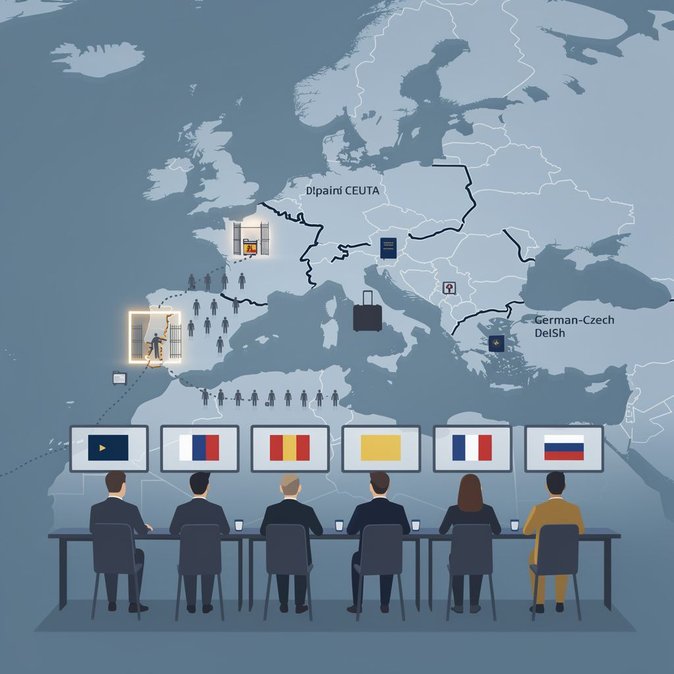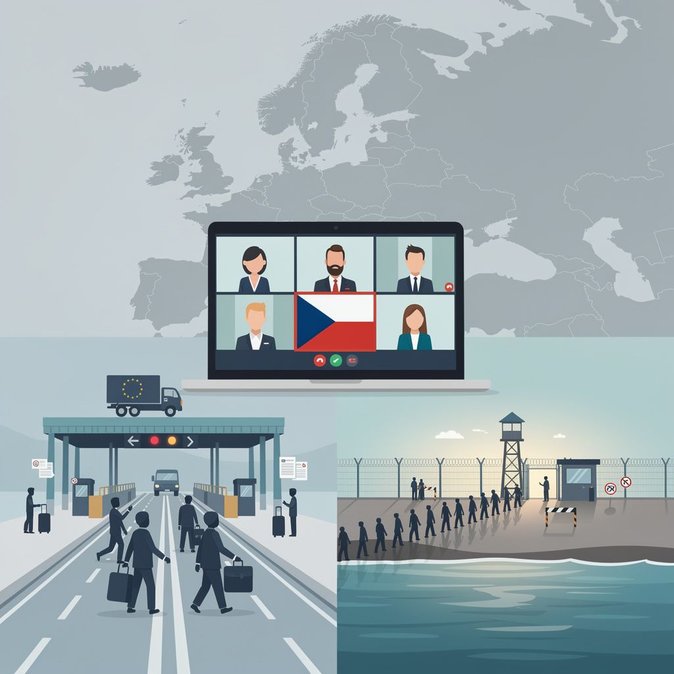
The Czech Republic’s interior minister Vít Rakušan cut short his summer holiday on 4 August to participate in an extraordinary videoconference of the EU’s 27 interior ministers, hastily convened after some 50 000 migrants crossed from Morocco into the Spanish enclave of Ceuta on 30 July. Although the migrants withdrew within 24 hours, the sheer scale of the incursion rattled governments across Europe and re-ignited long-simmering disagreements over burden-sharing inside the Schengen area. According to Le Monde’s report on the closed-door meeting, the Czech Republic was one of 22 member states that had already signed a sharply worded letter accusing Madrid of creating “pull factors” through its April regularisation plan for undocumented migrants. In Tuesday’s call, Rakušan reiterated Prague’s view that Spain must reinforce the EU’s external frontier and that the Commission should accelerate funding for Frontex deployments. At the same time, he rejected suggestions—floated by Denmark and Hungary—to re-impose systematic checks at Schengen’s internal borders, arguing that Czech exporters and cross-border workers “cannot become collateral damage of every migration flare-up.” For Czech corporates the episode is a reminder that political pressure can translate quickly into new compliance requirements. During last year’s Polish-German border crisis, the Czech police revived random ID inspections on trains arriving from Germany; logistics firms lost an estimated CZK 120 million in delays. Rakušan told reporters that Prague “is ready to re-activate mobile controls” if irregular movements shift towards Central Europe, but he sees “no operational justification at this point.” Still, the Ministry of the Interior has asked carriers to update contingency plans and to brief business travellers on potential spot checks after the summer holidays. Analysts note that the Czech position seeks to balance domestic politics and economic interests. The governing coalition faces pressure from the far-right Freedom and Direct Democracy (SPD) party to adopt a hard line, yet manufacturers desperately need smooth freight corridors to Germany and Spain, their two largest markets. “Re-introducing border checks every few months would shatter the credibility of the single market,” warns Ondřej Hák, mobility lead at the Czech Confederation of Industry. He urges companies to monitor the next Justice and Home Affairs Council on 5 September, when permanent Schengen reform will return to the agenda. In practical terms, HR and global mobility managers should: 1) alert travelling staff that ad-hoc police controls inside Schengen remain legally possible; 2) verify that all posted workers carry physical proof of residence and employment; and 3) follow Frontex situation updates, as major diversions on the Western Mediterranean route often reverberate in Central Europe within weeks. If temporary checks are re-introduced, employers may need to adjust posted-worker notifications and driving schedules at short notice.
Source: Le Monde