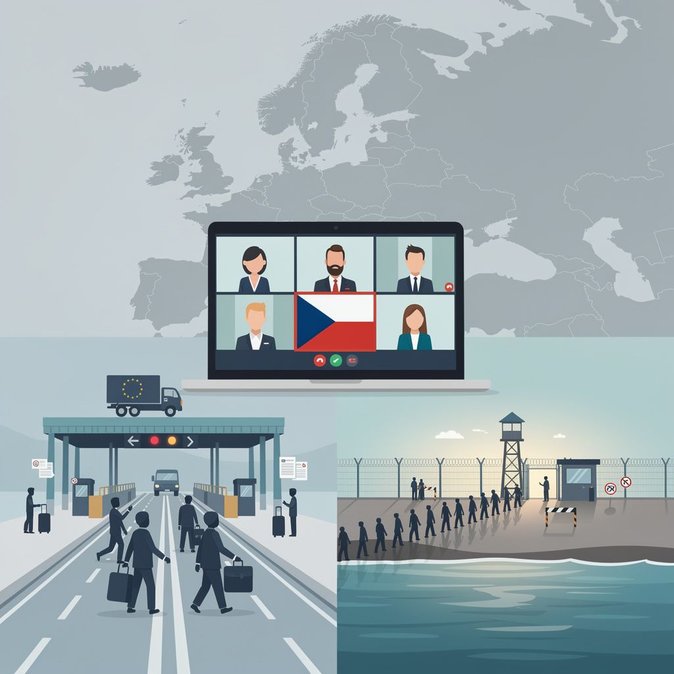
An extraordinary videoconference of the European Union’s 27 interior ministers was hastily convened on Tuesday, 4 August 2026, after nearly 50 000 migrants crossed into the Spanish enclave of Ceuta from Morocco on 30 July before being turned back within a day. Ireland, holder of the rotating EU Council presidency, called the meeting to demonstrate solidarity with Spain and to draw lessons from the incident, which briefly overwhelmed Spain’s border-control resources and stirred political tension across the bloc. In the run-up to the meeting, 22 heads of state and government—including those of the Czech Republic, Germany, Poland and Italy—sent a joint letter to EU institutions criticising Spain’s April 2026 regularisation programme for undocumented migrants and warning that “pull-factor” policies risk encouraging irregular crossings. The signatories urged the European Commission to support member states that re-introduce internal border checks and to accelerate work on external border protection measures authorised under the Schengen Borders Code. For Prague, the Ceuta episode is politically sensitive. The Czech government has kept its own land borders open but continues to face domestic pressure to curb secondary movements of migrants arriving through neighbouring Germany and Austria. Joining the letter allowed Czech Prime Minister Petr Fiala to align with like-minded states advocating tougher enforcement while avoiding unilateral action that could disrupt cross-border trade in the highly integrated Central European supply chain. Policy analysts note that the crisis comes less than four months after the EU’s new Entry/Exit System (EES) went live on 10 April 2026. Although the biometric system was designed to tighten controls at the EU’s external frontiers, it does not in itself address mass crossings such as those seen in Ceuta, highlighting the limits of technology-based solutions. Tuesday’s discussion therefore focused on rapid-reaction deployments of Frontex personnel, information-sharing with Moroccan authorities, and the possibility of activating Article 25a of the Schengen Code to allow temporary internal checks if similar events recur. For companies moving staff into or through the Czech Republic, the practical impact is two-fold. First, the political momentum behind stricter border controls increases the likelihood that neighbouring Germany will extend its existing land-border checks with Czechia beyond the current expiry of 15 September 2026, potentially adding time to road and rail journeys. Second, any EU-level agreement to harden external borders could slow visa issuance for third-country nationals whose travel itineraries include Spain or other frontline states. Mobility managers should monitor forthcoming Council conclusions (expected in October) and prepare contingency plans for possible spot-checks on Schengen internal frontiers.
Source: Le Monde